
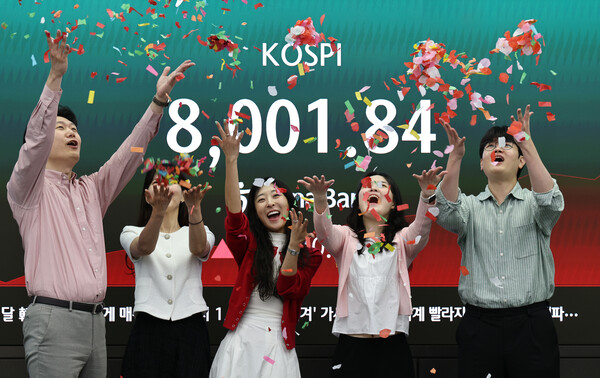
[DigitalToday reporter Sangyeop Oh (오상엽)] South Korea's KOSPI index broke above 8,000 intraday for the first time on Thursday. Expectations for a U.S.-China summit had already been priced in and weakness in U.S. chip stocks such as Micron weighed on the market, but a Nasdaq rise led by artificial intelligence stocks and an earnings surprise from chip equipment maker Applied Materials (AMAT) lifted investor sentiment.
The KOSPI rose to 8,000 just 7 sessions after first topping 7,000 on May 6. The index is up about 21 percent so far in May. Large chipmakers such as Samsung Electronics and SK Hynix led gains, and buying spread to automakers and some AI-related stocks, keeping the index near record highs.
◆ 8,000 driven by AI semiconductors
Semiconductors are at the center of the rise. Samsung Electronics and SK Hynix are seen as direct beneficiaries of expanding demand for memory chips needed for AI servers and data centers, including high-bandwidth memory (HBM), DRAM and NAND. As global AI investment expands, South Korean equities are being reassessed as a key market in the AI hardware supply chain.
When the KOSPI first broke above 7,000 on May 6, large chipmakers also drove the rise. The index closed at 7,384.56 that day, with Samsung Electronics jumping 14.4 percent and SK Hynix surging 10.6 percent. The two stocks accounted for 44 percent of the KOSPI's total market capitalisation. Foreign investors were net buyers of South Korean stocks worth 3.1 trillion won that day.
Earnings expectations underpin the rally. Expanded investment in AI data centers is lifting expectations for both memory chip prices and shipments. As hopes for a recovery in the chip cycle raise profit forecasts across the domestic market, concerns over low growth that had been a discount factor for South Korean equities are also easing somewhat.
Still, heavier reliance on large chip stocks is a burden. With Samsung Electronics and SK Hynix driving the index higher, the KOSPI has become more sensitive to moves in the two shares. Index volatility could also increase if AI investment sentiment weakens or profit-taking increases.
◆ South Korean market tops Taiwan; gap with India narrows
Breaking above 8,000 is not just a change in the index level. Total market capitalisation in the domestic market is also swelling rapidly, shifting global market rankings.
South Korea's stock market is already assessed as having surpassed Taiwan in size. Domestic market capitalisation recently exceeded 7,000 trillion won, and the KOSPI's move above 8,000 also expanded dollar-denominated market value further. The semiconductor-led rally has effectively driven South Korea's rise in global rankings.
The gap with India's stock market is also narrowing. But dollar-based market capitalisation rankings can change with exchange rates and stock price moves, so it is more appropriate for now to view it as entering range to catch India rather than a confirmed overtake.
The shift in South Korea's standing reflects the growing role of South Korean companies in the AI semiconductor supply chain. In the past, domestic equities were undervalued due to low shareholder returns, uncertainty over corporate governance and sensitivity to the business cycle. But improving semiconductor profits and expectations for higher corporate value are boosting expectations for easing the so-called Korea discount.
◆ Foreign selling is not a factor that will break the rally
After the move above 8,000, a key variable is foreign fund flows. While the KOSPI has surged about 21 percent so far in May, foreign investors posted net selling of about 20.2 trillion won over 8 sessions. By amount, it is the third-largest selling on record, after March and February 2026.
Still, it is difficult to interpret it immediately as a signal of an exit from the market. Ji-young Han (한지영), a researcher at Kiwoom Securities, said that with KOSPI market capitalisation now having grown to about 6,300 trillion won, selling of the same amount has less impact on the market than in the past.
Foreign net selling as a share of monthly average daily market capitalisation was 0.34 percent in May, lower than 0.47 percent in February and 0.81 percent in March.
The reason for foreign selling is also different from the past. In February to March, foreigners reduced stock holdings as concerns over a slowdown in the memory cycle overlapped with geopolitical risks, but expectations for a memory upcycle are now stronger.
Han analysed that the recent foreign selling is more about taking profits in semiconductors and autos that surged in the short term than about leaving the market.
Since May, semiconductors have risen 41.6 percent and autos have gained 29.2 percent. Foreign net selling also focused on the two sectors, at 16.8 trillion won in semiconductors and 800 billion won in autos. Profit-taking came first in the sectors that had led the index higher.
Han said there remains a possibility of profit-taking due to U.S. inflation burdens and after Nvidia earnings next week, but said the drivers of the stock market's rise have not been damaged.
Client deposits have increased to the 130 trillion won range, and consensus for KOSPI operating profit in 2026 has risen to about 890 trillion won. The forward price-to-earnings ratio (PER) also remains in the low 8 times range.
Han said it is unlikely that foreign net selling will lead to a shift into a downtrend and capital outflows. She added that short-term volatility could increase after the KOSPI's move above 8,000, but the rally's underlying momentum is being maintained as long as semiconductor earnings improve and abundant sidelined funds remain.
 Sangyeop Oh
yub@d-today.co.kr
Sangyeop Oh
yub@d-today.co.kr