
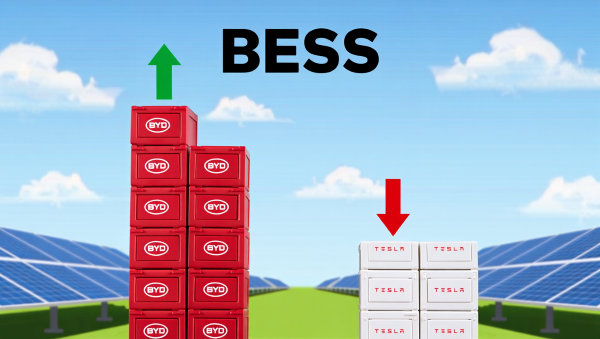
BYD ranked first in the global battery energy storage system (BESS) market in 2025, overtaking Tesla.
On May 13 (local time), electric-vehicle outlet Electrek reported, citing a tally by market research firm Benchmark Mineral Intelligence, that BYD’s 2025 market share was 13 percent and Tesla’s was 10 percent. Tesla ceded the top spot it had held for two straight years in 2023 to 2024. BYD shipped more than 60 gigawatt hours (GWh) over the year, while Tesla deployed 46.7 GWh. Tesla also grew 49 percent from a year earlier, but it did not match BYD’s pace of expansion.
Chinese companies dominated the top tier. Sungrow ranked third with 9 percent, while CRRC Zhuzhou, CATL and Hyperstrong each had 6 percent. Huawei and Envision each recorded 5 percent, and Fluence and Sunwoda each posted 4 percent. Among the top 10 companies, the only non-Chinese firms were Tesla and Fluence, a joint venture between Siemens and AES.
The market itself also grew quickly. Global BESS installations in 2025 totalled about 315 GWh, up 51 percent from a year earlier, and shipments of stationary storage battery cells exceeded 600 GWh, nearly doubling. In December 2025 alone, China’s large-scale battery installations reached 65 GWh, exceeding total U.S. deployments for the full year.
Product competition also intensified. BYD unveiled its Haohan energy storage system in September 2025, with a standard-configuration capacity of 14.5 megawatt hours (MWh). It had about three times the capacity of Tesla’s Megapack and was also deployed in a 12.5 GWh project with a Saudi power company. Tesla also responded that month by unveiling Megapack 3 and Megablock. At about 5 MWh per unit, it was an improvement on Megapack 2 at 3.9 MWh, and it is expanding its Houston Megafactory with a target of annual production of 50 GWh by the end of 2026. It also signed a $4.3 billion contract, worth about 6.4 trillion won, with LG Energy Solution to receive lithium iron phosphate (LFP) battery cells starting in August 2027.
Changes in market structure are also working against Tesla. The share held by specialised integrators that build systems by sourcing external cells rose to 30 percent in the first half of 2025 from 20 percent in 2023. BYD kept its top position while maintaining a vertically integrated structure that produces both cells and systems. Tesla, by contrast, sources Megapack cells from CATL, BYD and LG Energy Solution, and the lack of an in-house production base remains a factor in its long-term competitiveness.
This reversal goes beyond a simple change at the top and shows that the dominance of Chinese companies in the global energy storage market has strengthened further. The next point to watch for Tesla is whether the production expansion in Houston and the supply deal with LG Energy Solution lead to tangible results in cost and scale.
 Seungah Yoo
ysah@d-today.co.kr
Seungah Yoo
ysah@d-today.co.kr