
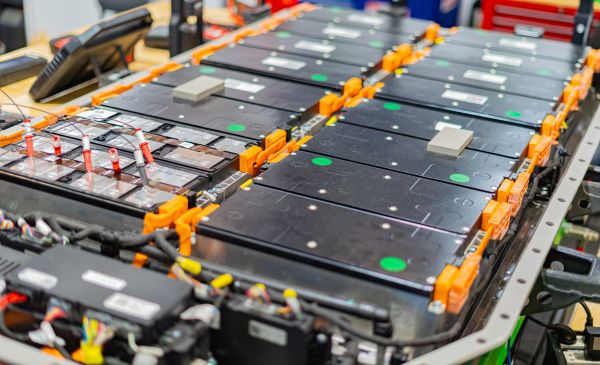
A study has found that controlling current with artificial intelligence during fast charging of electric vehicles can extend battery life by up to 23%.
On May 13, electric vehicle outlet InsideEVs cited an IEEE paper by researchers at Sweden’s Chalmers University of Technology and reported that an AI-based charging control method was confirmed to be effective in slowing battery degradation.
The key is applying reinforcement learning to the battery management system (BMS). The researchers designed the system to adjust current and voltage in real time during fast charging according to the battery’s chemical characteristics and state of degradation. As the battery ages, the structure changes charging conditions to reduce stress on the anode, cathode and electrolyte. The researchers said in the paper that the study was the first to systematically define the fast-charging problem across a battery’s full life cycle. They added that the proposed method achieved an “equivalent of 703 full charge-discharge cycles,” a 22.9% improvement over existing methods.
Electric vehicle batteries are designed to be used for years, but repeated fast charging speeds up aging. High-power charging places a load on internal cell components and, in some cases, can cause lithium plating in which lithium accumulates on the anode surface, leading to reduced battery performance. The AI-based BMS focused on minimising that burden.
The researchers stressed that the method does not extend life by sacrificing charging speed. The paper’s authors said, “Battery life can be greatly extended while maintaining charging efficiency, and it shows that life improvement is possible without sacrificing charging speed.”
A 23% increase in battery life could directly affect how long an electric vehicle is used. Given that Tesla battery life is estimated at 300,000 to 500,000 miles (about 480,000 to 800,000 km) depending on usage and charging patterns, the improvement could translate into additional driving range of tens of thousands of miles. The researchers, however, explained the effect in terms of charge-discharge cycles rather than actual driving distance.
The results are limited because they are still at the simulation stage. Since the findings have not been verified with an actual vehicle battery pack, whether it can be commercialised depends on whether the same performance can be reproduced in real-world conditions. Even so, the impact could be significant if applied in practice. Drivers who rely on fast charging could delay battery replacement, and it could affect battery warranty policies and used electric vehicle values. Extending battery life could also be expected to have environmental benefits by reducing demand for raw materials and manufacturing burdens.
The study shows that competition in electric vehicle batteries is expanding beyond energy density and charging speed to long life and degradation management. The point to watch is whether AI-based charging control can be installed in an actual vehicle BMS and prove the same life extension effect in real-road conditions.
 Seung-a Yoo
ysah@d-today.co.kr
Seung-a Yoo
ysah@d-today.co.kr