
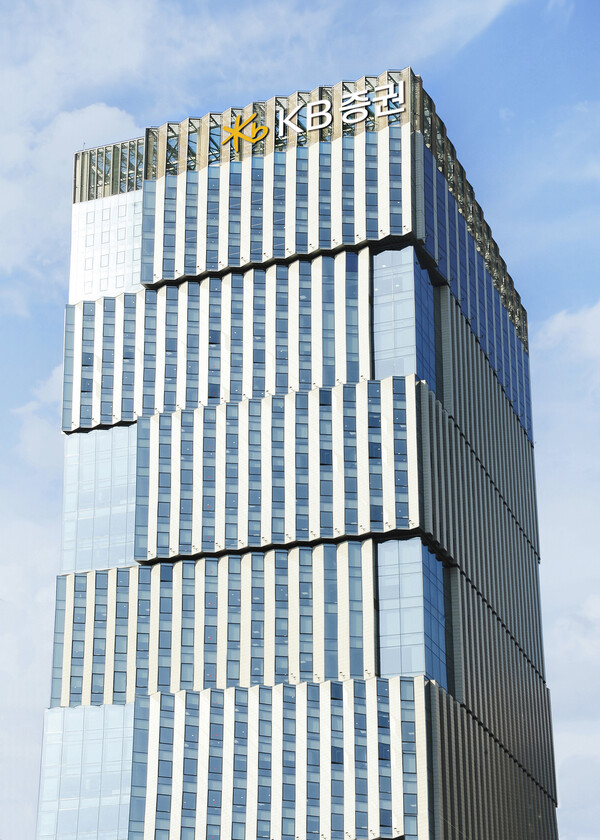
KB Securities raised its KOSPI target for this year by 40 percent to 10,500 from 7,500. It cited a view that the pace of corporate earnings improvement driven by expanding artificial intelligence (AI) investment is outstripping the index’s rise.
KB Securities presented a KOSPI target of 10,500 for this year in its “KB Strategy” report published on May 14. The report said the current KOSPI market is showing a faster and stronger trend than the “three-low boom,” which is seen as the strongest bull market in the past.
The report cited AI investment as a key driver of the current rally. It said expanding AI infrastructure investment is leading upgrades to earnings estimates, centered on semiconductors, while KOSPI earnings forecasts are rising faster than the index, easing valuation pressure at the same time.
It also estimated 2026 KOSPI operating profit at 919 trillion won, triple from the previous year. It said an overwhelming pace of earnings improvement is expected even compared with global stock markets.
It forecast that combined operating profit at Samsung Electronics and SK Hynix will expand to 630 trillion won in 2026 and 906 trillion won in 2027, from 91 trillion won in 2025.
It expected 2027 KOSPI operating profit to top 1,000 trillion won, reaching 1,241 trillion won. KB Securities said such profit growth could serve as a basis for further KOSPI gains.
The report assessed memory semiconductors and humanoid robots as key strategic assets in the AI infrastructure era. It forecast the AI market will enter the agentic AI stage in 2026, then expand from cloud-centric server AI to on-device AI, with its growth path broadening into physical AI from 2028.
It said real-time inference without delay will become important in agentic AI and physical AI, making expanded memory semiconductor capacity and securing a humanoid robot value chain essential.
It said Samsung Electronics, SK Hynix and Hyundai Motor, among others, are likely to be re-evaluated as scarce strategic assets that determine AI infrastructure performance, beyond being simple hardware companies.
On concerns in some quarters about a bubble collapse, it assessed the possibility as limited. KB Securities said there is unease due to a sharp market rise, but a bubble does not burst simply because prices have risen a lot.
It said clear signals such as a breakdown in the business cycle or a sharp rise in interest rates would be needed, but the likelihood of such signals emerging in the short term is not high.
It named AI-related sectors such as semiconductors, robots, power and space as future market leaders for the KOSPI. It forecast that, as leader-stock concentration tends to repeat in a bull market, the focus is more likely to remain on AI-related shares rather than spreading broadly across rising sectors.
Kim Dong-won (김동원), head of KB Securities’ research division, said, “Despite an overwhelming earnings improvement outlook, with this year’s operating profit estimated at 919 trillion won, triple from a year earlier, the current KOSPI market is trading at more than a 30 percent discount to the average for emerging Asian markets, with a price-to-earnings ratio (PER) of 7.9 times, a price-to-book ratio (PBR) of 1.8 times and return on equity (ROE) of 25 percent.”
“Korea has an industrial structure optimized for building AI infrastructure such as semiconductors, power and robots, so despite the recent rise in the index, there is ample upside potential for the KOSPI,” he added.
 Oh Sang-yup
yub@d-today.co.kr
Oh Sang-yup
yub@d-today.co.kr