
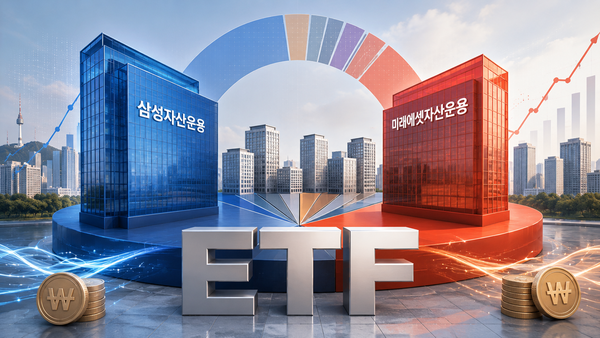
[DigitalToday reporter Sangyeop Oh (오상엽)] South Korea’s exchange-traded fund (ETF) market is growing rapidly, intensifying competition for market share among asset managers. Samsung Asset Management remains the clear No. 1, but its share has fallen below 40 percent. Mirae Asset Management is closing in with a share in the low 30 percent range, while mid-tier managers are moving to expand by promoting active ETFs and theme-based products.
As of May 12, total net assets in South Korea’s ETF market stood at 465.9816 trillion won, according to SEIBro data from the Korea Securities Depository on Wednesday. The total number of ETF listings was 1,108.
Samsung Asset Management held 184.6708 trillion won in net assets, accounting for 39.64 percent of the total. It kept its top ranking by assets but its share slipped to the 40 percent line. Second-ranked Mirae Asset Management had 147.6193 trillion won, for a 31.69 percent share. The gap between the two was 7.95 percentage points.
Samsung Asset Management and Mirae Asset Management together held a 71.33 percent share. The domestic ETF market still moves around a duopoly, but demand for tax-saving accounts, retirement pensions and theme-based products is rising. That is making competition for share more segmented by manager.
Samsung Asset Management has maintained the top spot in the domestic ETF market with its KODEX lineup. After listing South Korea’s first ETF, the KODEX 200, in 2002, it has rolled out sector ETFs, overseas-focused ETFs, bond ETFs and derivatives-based ETFs in succession, leading market expansion.
But as the ETF market grows, investor demand has split into domestic equity, overseas equity, bond, thematic and active segments. That has made defending market share structurally difficult.
Mirae Asset Management is growing its scale on the back of its global ETF business and the pension market. As of the end of February this year, its total assets under management stood at about 598 trillion won. Global ETF net assets total 367 trillion won, and it ranks 12th among global ETF managers.
The recent strength of the domestic stock market worked in favor of Samsung Asset Management, which holds flagship index-tracking ETFs. Mirae Asset Management, by contrast, has a high share of overseas-focused ETFs and global asset-allocation products. In an inflow phase centered on domestic equities, its share gains are seen as having been relatively limited.
Below the top two, Korea Investment Management and KB Asset Management posted shares in the 7 percent range. Korea Investment Management ranked third with 33.7886 trillion won in net assets and a 7.25 percent share. KB Asset Management followed with 33.4251 trillion won and a 7.17 percent share.
Shinhan Asset Management posted 19.7013 trillion won for 4.23 percent, and Hanwha Asset Management had 12.7423 trillion won for 2.73 percent. Timefolio Asset Management held 8.2269 trillion won for 1.77 percent, NH-Amundi Asset Management had 7.2638 trillion won for 1.56 percent, and Kiwoom Asset Management accounted for 6.6838 trillion won, or 1.43 percent.
Mid-tier managers are targeting niches with active ETFs and specific industry theme products rather than competing with big players on scale. Timefolio Asset Management has relatively few listings, but it is increasing net assets by emphasizing active ETF performance.
Earlier, in Koscom’s ETF CHECK data on manager standings for April, Timefolio Asset Management moved ahead of NH-Amundi Asset Management and Kiwoom Asset Management, driving shifts in the mid-tier rankings.
The overall size of the ETF market is also expanding quickly. As of the May 11 close, 96 ETFs had net assets of at least 1 trillion won, according to FnGuide. That is an increase of 29 in about 5 months from 67 at the end of last year.
The rise in domestic equity ETFs was particularly notable. The number of domestic equity ETFs with net assets of at least 1 trillion won rose to 43 from 23 at the end of last year. Over the same period, overseas equity ETFs increased only to 22 from 19. That is seen as a result of investor money moving into domestic equity ETFs as the domestic stock market strengthened.
For managers, expansion of the ETF market can lead to higher fee income because the base for management fees grows as net assets rise. Competition to cut fees has continued, particularly for passive ETFs, but products with relatively higher fees, such as leveraged ETFs and active ETFs, make a large contribution to performance.
The Korea Exchange said semiconductor and IT sector leveraged ETFs ranked among the top performers in South Korea’s ETF market this year. Management fees, a key revenue source for managers, are calculated in proportion to a fund’s net asset value, so a rising market and net asset growth can support improved earnings.
But as market growth meets intensified competition for share, investor protection issues are also coming into focus. Some managers have recently faced controversy over making ETF holdings appear larger than they are during promotions or using wording that could mislead investors.
Shinhan Asset Management’s SOL AI Semiconductor TOP2 Plus ETF drew criticism that it mixed expressions for direct inclusion weightings and investment exposure when promoting its investment weight linked to SK Hynix.
Hana Asset Management also corrected an advertisement for its 1Q U.S. Aerospace Tech ETF after it used wording related to SpaceX, an unlisted company.
The Financial Supervisory Service is also looking into related matters. The watchdog is reported to have recently conducted on-site inspections of some ETF advertising cases and checked whether there were deficiencies in internal controls.
A Financial Supervisory Service official said, "We conducted on-site inspections of some recent cases," adding, "From the internal control perspective, we identified parts with potential legal violations and shared them with the inspection bureau, and we are also widely informing asset managers about compliance-monitoring risks through CEO meetings and other channels."
 Sangyeop Oh
yub@d-today.co.kr
Sangyeop Oh
yub@d-today.co.kr