
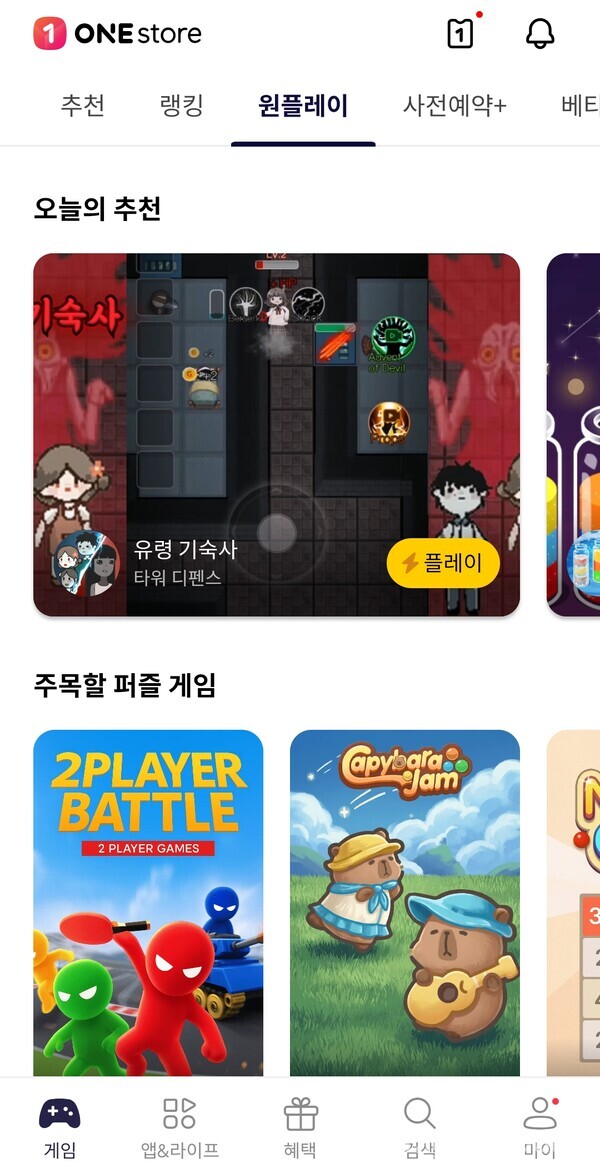
‘Minigames’ that can be played immediately without installing a separate app on a smartphone are emerging as a new weapon in platform competition. For users, they are light entertainment. For platform operators, they are a low-cost touchpoint to test advertising and payments, and even D2C (Direct to Consumer) sales.
Against this backdrop, OneStore’s move stands out. OneStore unveiled its no-install minigame service, OnePlay Game, at a press briefing marking its 10th anniversary on April 30. About 20 titles are currently in pilot operation, and a formal launch is scheduled for this month. OneStore plans to roll out OnePlay Game in cooperation with Tencent, which has built experience in the global minigame market.
OneStore’s choice of minigames reflects a decision to adopt rules different from those of existing app markets. Traditional app markets operate by ranking apps based on download counts and revenue tallies. Minigames run in a web format without installation, so they do not fit that tally structure. Even so, OneStore chose to introduce them to broaden user touchpoints beyond being a simple download platform.
What OneStore is focusing on in OnePlay Game is not the minigame content itself but the revenue structure connected behind it. It plans to include a rewarded ad-watching model and link its own login and payment infrastructure to create a flow inside the app, from launching a game to buying items. Its D2C payment service, OneWebshop, unveiled the same day, is also tied to this strategy. OneWebshop is a service that sells game items with an 8 percent fee, including payment gateway fees, and is set to launch in late May. OneStore presented an “all-in-one store,” where downloads, payments and play happen on a single platform, as a mid- to long-term growth strategy.
Toss is accelerating the expansion of a miniapp ecosystem that includes minigames. Through App in Toss, a miniapp platform launched in July last year, it opened its user base of more than 30 million and its financial infrastructure to external partners as part of its “super app for everyday life” strategy. This is seen as a plan to increase user time spent by combining games and daily and convenience services within a financial app.
Its expansion in scale is also rapid. Partner miniapps, which numbered about 100 at launch, topped 1,000 in February this year and surpassed about 4,000 as of May 7. Of these, about 800 are game apps, accounting for around 20 percent of the total and establishing themselves as the most active category. There was also a case in which a non-developer used generative AI to launch 21 miniapps in 2 months and recorded a peak click-through rate of 20.9 percent. As entry barriers for providers fall, analysis suggests it could become a new distribution and revenue channel not only for professional developers but also for individual developers.
Toss’s moves in games do not stop at providing a platform. After moving to hire for game publishing roles last year, Toss added “game software production” to its business purposes this year. In the industry, there is an interpretation that Toss is expanding its business scope beyond simple platform operation to game distribution and operations.
Behind OneStore and Toss focusing on minigames and miniapps is a change in user behaviour. In a survey of 46,224 people conducted by Kakao Pay through its journal Pay Attention, about 70 percent of respondents said they feel burdened by installing a new app to play a game. As app installation, large downloads and regular updates become more complicated, more users are seeking lighter and more immediate ways to consume content. Minigames can run immediately with a single load, aligning with such demand.
Kakao exit offers lesson... time spent alone not enough, monetisation key
A representative domestic example of platform-style minigames is Kakao. Kakao Games operated Snack Games within KakaoTalk from 2016, offering 37 titles. It leveraged the user base of a major domestic messenger platform but ended the service in 2023 after failing to overcome low usage rates and low profitability.
Kakao’s exit shows that minigames can be hard to turn into a sustainable business on accessibility alone. Even if installation barriers are lowered, it is difficult to establish a long-term service within a platform without repeat visits and a monetisation structure. In that sense, OneStore foregrounding payment infrastructure linkage and Toss combining financial infrastructure with miniapp monetisation tools can be seen as attempts to address monetisation limits that past minigames faced.
Global platforms are already using minigames as a tool to expand their platforms. Telegram began HTML5-based game services in 2016, and since 2023, reward-based game models linked to the TON ecosystem have also spread based on Telegram miniapps. Still, this is closer to an ecosystem expansion trend formed by combining miniapps and blockchain projects than to a single game service directly operated by Telegram.
Discord also introduced casual games that users within servers can enjoy together in 2022, using games as a way to increase time spent in communities and interaction among users.
YouTube is also operating an in-app game service called Playables in 2024, but access is blocked from Korean IP addresses due to the impact of South Korea’s pre-review regulation for games. YouTube Playables limits external in-game payments and external advertising, so for now it can be viewed as a service weighted more toward expanding time spent and strengthening content experiences within the platform than toward direct payments.
China is virtually the only country where minigames have become mainstream on platforms. According to OneStore, China’s minigame market is worth 11.5 trillion won and accounts for 15.3 percent of the country’s overall game market. Tencent’s WeChat and Alibaba’s Alipay are cited as factors, having built ecosystems that combine minigames with payments and daily life services.
An industry official said, “Minigames have a low entry barrier, but their structure also makes it easy for users to leave, so it may not be difficult to gather traffic itself.” The official said, “Whether users actually make payments within minigames will determine business sustainability, and until that proof emerges, everyone is in an experimental stage.”
 Ho-jung Lee
lhj@d-today.co.kr
Ho-jung Lee
lhj@d-today.co.kr