
Ahead of the enforcement of the revised Information and Communications Network Act, discussions in South Korea's platform industry on self-regulation of false and manipulated information are gaining pace. The follow-up moves come after the law included false information and manipulated information as items subject to legal regulation and imposed duties on platform operators above a certain size to establish reporting and action systems and self-operating policies.
The Korea Internet Self-Governance Organization (KISO) on Tuesday held a special seminar in Seoul with the Korea Association for Information and Telecommunication Policy and the Korea Information Society Development Institute (KISDI) on self-regulation of false and manipulated information following revisions to the act. It released a draft of its self-policy guideline on false and manipulated information. Key issues included the possibility of restricting freedom of expression, concerns about overblocking, the scope of application to messenger and search services, and the effectiveness of fact-checking.
Legalisation of false and manipulated information ... new duties for large platforms
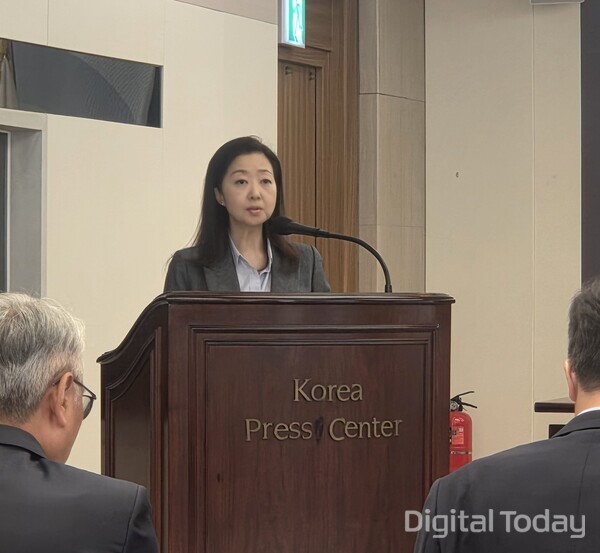
Cheon Hye-sun (천혜선), a research fellow at the Digital Industry Policy Institute, who delivered the first presentation, explained the legislative process and main content of the revised act.
The revised law creates a new concept, "false and manipulated information", combining false information and manipulated information. It bans distribution of information that infringes on another person's personality rights or property rights, or the public interest, with the intent to cause harm or to obtain unjust gains, while knowing it is false and manipulated information. Satire and parody are excluded from its scope.
The scope of illegal information also adds hate speech. It includes information that incites violence or discrimination against a specific individual or group based on race, gender or disability, or that fuels hatred and significantly undermines dignity.
The damages regime has also been strengthened. If illegal information or false and manipulated information causes damage to others, the distributor bears liability for damages. Punitive damages of up to five times the recognised damage amount are also possible for posters who meet certain criteria.
New obligations were also introduced for large information and communications service providers. The main items include operating reporting and action systems, establishing self-operating policies, preparing and publishing reports every six months, and supporting fact-checking activities. A draft revision to the enforcement decree presented a standard for large information and communications service providers as intermediary services for user-to-user information and search services with a daily average of at least 1 million users over the previous three months as of the end of the prior year.
A basis was also 마련됐다 for the Broadcast Media Communications Commission to impose administrative fines of up to 1 billion won when illegal information or false and manipulated information that has received a final court ruling is distributed repeatedly at least twice.
KISO elaborates judgment criteria ... "could effectively become a standard for legal interpretation"
Hwang Chang-geun (황창근), a professor in the law department at Hongik University and a KISO policy committee member, who delivered the second presentation, introduced the main content of KISO's draft self-policy guideline on false and manipulated information.
The guideline sets out four basic principles: harmonising freedom of expression and the right to know, minimising harm, transparency, and proportionality and objectivity. As criteria for judgment, it presented intent to cause harm, the purpose of obtaining unjust gains, whether content constitutes false and manipulated information, and whether it infringes personality rights, property rights or the public interest.
Hwang said, "The guideline is an autonomous norm of private self-regulation, but it also has the character of a co-regulatory norm that specifies the concept and requirements of false and manipulated information under delegation by the law." He added, "It may also function in practice as a standard for legal interpretation in court rulings on damages or the commission's imposition of administrative fines."
The guideline, considering the protection of communications secrecy, in principle excludes user-to-user message delivery services such as messengers and email from its scope. KISO also established a procedure to request deliberation by a special false and manipulated information review committee for cases that member companies find difficult to 판단하다.
Experts: "need to supplement legal basis and practical application"
In the discussion, participants continued to call for improvements to the legal basis and procedural control, and to the feasibility of practical application.
Kim Hyun-soo (김현수), head of KISDI's Digital Policy Research Division, said legal control over procedural fairness is needed for an industry association's guideline to operate as a de facto standard for 판단하다 of false and manipulated information. He also said 대응 means tailored to service characteristics are needed because impersonation and sharing of false information take place on messaging services such as KakaoTalk as well.
Shim Seok-tae (심석태), an adjunct professor at Semyung University's Graduate School of Journalism, said, "There is little 의미 in debating right and wrong again now that the law has already been made, but there are still many regrets." He said the looseness of the law itself increased the importance of the guideline and stressed that it should be designed with precision so that freedom of expression, including that of the media, is not excessively controlled.
Oh Byung-il (오병일), head of the Digital Justice Network, said the scope of false and manipulated information that is being newly criminalised remains unclear. Because it is difficult for a third party to judge a poster's malicious intent, he said the core of the response lies in a fact-checking culture and platforms' structural responsibility rather than deletion, and suggested a broader self-regulation system that includes strengthening user capabilities and controlling algorithms.
Lim Hyun (임현), a professor in the public administration department at Korea University, said it is important to secure democratic legitimacy and procedural transparency because the guideline will have considerable influence. He said when detailed criteria are changed in the future, there should be a process to gather stakeholders' 의견, and warned that if the scope of unjust gains is interpreted too broadly, the scope of regulation could expand excessively.
Jung Yeon-ah (정연아), a lawyer at Law Firm Sejong, raised concerns about the possibility of overblocking in practice. She said operators are likely to make safe judgments to avoid legal risks, which could lead to restrictions on freedom of expression. Jung proposed criteria distinguishing public figures from private individuals and guidelines by level of action, and suggested keeping open various measures beyond deletion and blocking, including notifying users of fact-check results.
At the seminar, participants said self-regulation is needed to respond to false and manipulated information. They also said because self-regulation is likely to go beyond filling gaps in law enforcement and operate in practice as a standard for judgment, it is necessary to precisely design the balance between freedom of expression and user protection.
KISO plans to review opinions raised at the seminar and revise and finalise its self-policy guideline on false and manipulated information.
 Lee Ho-jung
lhj@d-today.co.kr
Lee Ho-jung
lhj@d-today.co.kr