
[Digital Today reporter Seulgi Son] The IPTV industry urged the Korea Communications Commission to ease regulations on fees, terms and conditions, and advertising.
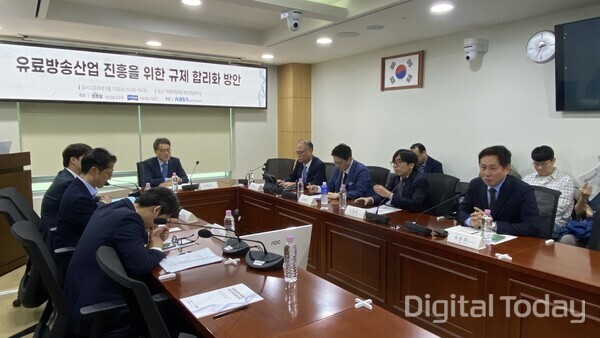
At a seminar titled "Regulatory rationalisation measures to promote the pay-TV industry" held on May 13 at the National Assembly Members’ Office Building, Yoo Yong-hwa (유용화), head of the Korea IPTV Broadcasting Association, said, "I hope a bill passes at the autumn regular session of the National Assembly and opens a path to promoting the broadcasting industry." The event was co-hosted by lawmaker Kim Woo-young and lawmaker Lee Hae-min.
The industry is making improvements to fee regulations its top priority. Kim introduced an amendment to the Internet Multimedia Broadcasting Business Act, or the IPTV Act, last November that would convert the IPTV fee approval system into a reporting system. The key is to abolish the Korea Communications Commission's approval procedure applied to minimum-channel products and bundled product fees. The amendment was placed on the agenda of a full meeting of the National Assembly’s Science, ICT, Broadcasting and Communications Committee in February, but was only referred to a subcommittee and was not processed within the first half of the term.
Pay-TV subscribers total more than 36 million terminals, sustaining a nationwide media platform, but the industry’s crisis is visible in the figures. Broadcasting advertising fell 18.5 percent from a year earlier. The number of dramas produced fell 17.6 percent and outsourced production time dropped 15.8 percent. Park Sung-soon (박성순), a professor in the Department of Film and Media at Seoul Institute of the Arts who presented at the seminar, said falling revenues for pay-TV platforms form a vicious cycle that leads to a contraction of the entire content industry.
Subscriber numbers appear stable on the surface. Park cited low fees and the structure of internet bundle products as the reason. "Even now, in the high 10,000 won range to the low 20,000 won range, you can watch the internet and various channels, so it is a structure where it is bothersome to cancel," he said. The problem, he said, is that costs are not circulating. "If it is being maintained at the same cost as when ramen and gimbap used to cost 2,000 to 3,000 won, that market is not stagnating but effectively retreating," he said.
Pay TV is a core distribution channel for broadcasters, production companies and channel operators, or programme providers, and there is a view that IPTV, in particular, could develop into a hub that links the content value chain by combining with telecommunications. "This infrastructure must not decline," Park said. "Like AI, the media content industry is also a very important area in our country, so the industry growth infrastructure needs to develop."
The assessment was that regulatory improvements are urgent. Terms and conditions regulation is a representative example. Under the Broadcasting Act, pay-TV operators must file a report with the Korea Communications Commission and receive acceptance when changing their terms of service. Park said sufficient regulation is possible under the terms and conditions law under the jurisdiction of the Fair Trade Commission. "Yesterday I received an email saying the terms changed at Disney Plus. User protection is fully possible even with the terms law, which is post regulation," he said. He proposed separately regulating channel transaction issues to protect weaker parties such as programme providers through dispute systems and prohibited acts.
Rigid broadcasting advertising regulations also need to change, he said. Broadcast advertising is subject to volume, item and time-slot regulations under the Broadcasting Act, and is also entangled with various laws including the National Health Promotion Act, the Juvenile Protection Act and the Special Act on the Safety Management of Children’s Dietary Life. By contrast, OTT services are classified as value-added telecommunications services and are not subject to the same regulations. "Fast-food ads are banned during youth protection hours, but those youths are now watching hamburger mukbang on YouTube," Park said, pointing to a gap with reality. He also proposed building a basis for integrated advertising transactions across broadcasting and OTT and establishing an integrated audience rating system. "A 1 percent rating is about 500,000 people, and we need a system that can compare it on the same standard as 500,000 YouTube subscribers," he said.
US Communications Commission: "We agree with direction of easing fee rules... consider balance in viewer protection"
The Korea Communications Commission signalled it agrees with the direction of deregulation but needs to pace the changes. Kang Dong-wan (강동완), director of the commission’s New Media Policy Division, said, "We agree with the purpose that deregulation is needed so businesses can freely design fees, products and services, and we also agree with the direction of shifting from a pre-regulation focus to a post-regulation focus." He added, however, "We must comprehensively consider protecting viewers’ rights and interests, stability in channel transmission, and the balance of negotiations between pay-TV operators and content companies."
He said the commission is also reviewing ways to combine supplementary post-regulation measures, such as notifications of changes to terms, if the acceptance-reporting system is eased into a self-contained reporting system. "In the process of the bill moving forward, stakeholders’ opinions will be gathered and a balanced proposal will be made," Kang said.
 Seulgi Son
sageson@d-today.co.kr
Seulgi Son
sageson@d-today.co.kr