
The government will respond proactively to changes in future society by reflecting the perspectives and expertise of science, technology and artificial intelligence (AI) specialists. Experts recommended monitoring AI use levels nationally so gaps do not become entrenched. They also made it clear that AI cannot replace people entirely.
The Ministry of Science and ICT on May 13 held a launch ceremony for the Science and Technology-AI Future Strategy Council and convened its first meeting at the National Science and Technology Advisory Council in Gwanghwamun, Seoul.
The Future Strategy Council is a consultative body that identifies the government’s mid- to long-term strategic agenda and seeks policy directions to respond to social change triggered by advances in science, technology and AI. It consists of 17 private-sector experts spanning the whole of society, including researchers in science, technology and AI, as well as the economy, industry, education, healthcare, culture and law.
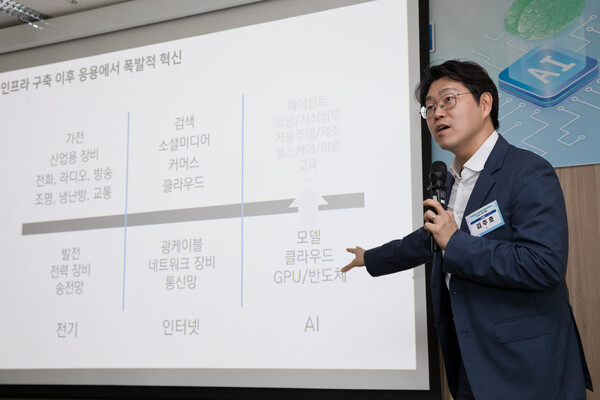
Experts who delivered presentations stressed that AI cannot replace all human roles. Kim Joo-ho (김주호), a professor at KAIST’s Kim Jaechul Graduate School of AI and the School of Computing, said, "AI will play a role in making people’s roles more important."
Deep learning pioneer Geoffrey Hinton previously argued in 2016, 10 years ago, that "AI will replace radiologists within five years." Kim said that contrary to that outlook, AI expanded the scope of medical diagnosis and played a role in "augmenting" humans.
He advised that to improve capabilities in using AI, the quality of AI use should be monitored at the national level. As AI use increases, skilled workers could instead become less skilled, or beginners could struggle to build the capabilities they need.
Kim said, "We need a system that can measure in real time capability degradation or usage gaps stemming from AI use," adding, "If the benefits of technological advancement are to return to society as a whole, systems must be designed alongside it."
Kwon Han-seul (권한슬), head of Studio Freewillusion and South Korea’s first AI film director, shared a similar view. Kwon said AI clearly helps with decision-making and tasks needed for film production, but human roles are also essential. In the open discussion, debate focused on ways for humans and AI to coexist. Views were also expressed on reorganising industrial, economic and social structures driven by advances in cutting-edge technology.
The ministry will hold the Future Strategy Council quarterly starting with this first meeting. It will conduct in-depth research on key agendas that emerge from the meetings in cooperation with relevant research institutions. It will release the research results sequentially in the form of a "Future Agenda Series". Issues requiring pan-government cooperation will be discussed at the Science and Technology Ministers’ Meeting to secure policy execution.
Deputy Prime Minister and Science Minister Bae Kyung-hoon (배경훈) said, "We are facing a period of major transformation in which technological innovation fundamentally changes the national system and daily life," adding, "We will gather the wisdom of top experts in each field and design a hopeful blueprint for future generations."
 Jin-ho Lee
jhlee26@d-today.co.kr
Jin-ho Lee
jhlee26@d-today.co.kr