
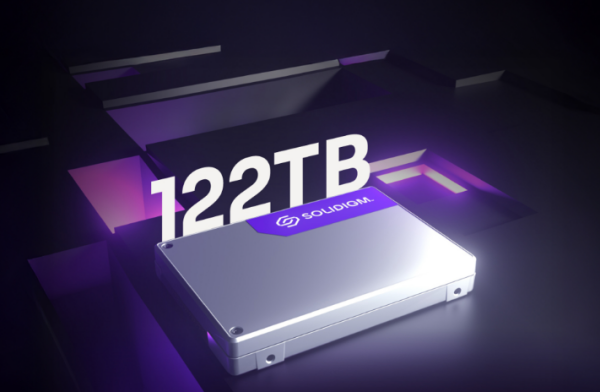
[DigitalToday reporter Jinju Hong (홍진주)] Solidigm’s largest-capacity enterprise SSD, the D5-P5336, is sending shockwaves through the enterprise storage market after posting a roughly 200 percent price surge just nine months after launch.
Tech outlet TechRadar reported on Feb. 24 local time that the product was first unveiled in November 2024 and began official sales in May 2025. The initially expected price was about $14,000, but the actual launch price came in at $12,399, well below market expectations. At the time, the price per terabyte was about $101, and it was seen as relatively reasonable despite its ultra-high capacity.
The same product is now selling for $37,128. That is close to a threefold increase in nine months. Discounts are offered for bulk purchases, but even orders of more than 100 units reduce the price by only about $853 per drive.
The D5-P5336 is a 2.5-inch U.2 SSD using a PCIe 4.0 x4 interface and is aimed at servers, storage arrays, and cloud and data centre environments. It is designed at 15 mm thick and weighs about 166.5 g, integrating 122.88TB of capacity. Sequential performance is up to 6.84 GB per second for reads and 2.93 GB per second for writes. It delivers 900,000 IOPS for 4KB random reads and 19,000 IOPS for random writes, optimised for read-centric workloads. Endurance is 0.6 DWPD, and total bytes written is listed at 137,523.20TB. Mean time between failures is presented as 228.2 years, but this is a statistical estimate. It comes with a five-year warranty, and the U.2 interface is mainly used in enterprise server environments.
Limited production scale for ultra-high-capacity NAND is cited as a reason for the price surge. Such large-capacity flash is not mass-produced like mainstream products, and supply can tighten quickly if hyperscale data centre customers place large orders. Enterprise SSDs are also often priced under contracts, unlike consumer products, so listed retail prices can fluctuate widely depending on inventory conditions and distributor adjustments.
At the current price, the cost per terabyte is about $302. That is far higher than high-capacity consumer NVMe SSDs, which typically cost $40 to $80 per terabyte. It is also more than twice as expensive as 7.68TB to 30.72TB enterprise SSDs that trade at under $150 per terabyte in bulk purchases.
Even so, a simple price-per-capacity comparison is not the whole picture. The ability to fit 122.88TB into a single 2.5-inch U.2 slot can reduce drives per rack, ports, cables and power consumption, providing practical value to data centre operators constrained by space and power. Still, the rise from $101 to $302 per terabyte is likely to weigh heavily on purchasing decisions.
The D5-P5336 case is drawing attention as a clear example of how sharply prices in the ultra-high-capacity enterprise storage market can swing depending on supply, contract structures and concentrated demand.
 Jinju Hong
hongjj@d-today.co.kr
Jinju Hong
hongjj@d-today.co.kr