
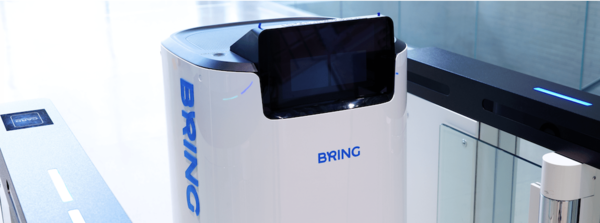
Kakao Mobility is moving ahead in its robot platform business. It aims to apply the dispatch and control technology built through operating the Kakao T taxi platform to robots in the field and take the lead in an integrated operations platform not tied to any manufacturer.
Kakao Mobility on Tuesday held a media seminar at Kakao Agit in Pangyo and unveiled the technical architecture and business direction of its in-house 'KM Autonomous Agent Platform'.
Kang Eun-gyu (강은규), leader of the future business platform, said the narrowing technology gap among manufacturers, driven by the levelling-up of robot hardware, is shifting the industry's key task from building more sophisticated robots to operating and controlling multiple robots deployed in the field through a standardised system.
Kakao Mobility said it is focusing on the platform business based on quantitative results confirmed in the field. In 2024, it partnered with autonomous driving robot specialist Robotis to operate commercial robot delivery models at major hotels in South Korea. Robotis has seen average daily robot utilisation rise about eightfold from the early stage after adopting Kakao Mobility's platform, the company said. It also said room-service sales revenue rose about threefold after combining a platform-based QR ordering system.
Its areas of application are also expanding. Kakao Mobility first began full-scale beverage delivery services at the Pangyo Alphadom office building and later expanded deployments to multiple hotels and Soonchunhyang University Hospital. At Soonchunhyang University Hospital, robots are replacing repetitive work in which nurses twice an hour brought patients' medicines in boxes from an underground pharmacy and distributed them. For hotels, the company said a switch to 24-hour free room service has also produced labour cost savings.
The company said smarter robots and smoothly running services are separate issues. Oh Doo-yong (오두용), leader of robot development, said a service does not run smoothly based only on how fast a robot moves or how accurately it grips items. He said there are elevators, people, unexpected situations and multiple robots moving at the same time in actual sites. Decisions such as what to do when a robot reaches its destination and the recipient is away, or when a robot stops mid-delivery, are part of the service execution system rather than the robot's own intelligence, he said.
INTEGRATED OPERATIONS FOR DIFFERENT ROBOTS
Kakao Mobility said it will act as an 'orchestration layer' in this area. The platform consists of four core technical elements: 'Task', which abstracts service requests into units robots can execute; 'Command Interface', which connects different types of robots through a standard API; 'Reallocation', which reassigns missions to other robots when breakdowns or communication failures occur during operation; and 'Integration Backbone', which handles linkage with building infrastructure and existing systems.
The operating principle resembles Kakao T taxi's AI dispatch logic. When a passenger calls a taxi, the optimal vehicle is assigned by considering the estimated arrival time and call information among nearby available cars. Likewise, when a robot service request comes in, the platform selects the optimal robot from the available pool by weighing distance to destination, remaining battery, remaining workload for ongoing tasks and qualifications to handle the task. Oh said the DNA of Kakao Mobility's accumulated dispatch technology is embedded in the robot platform and that the structure can work the same way even if other types of autonomous agents are introduced.
Kakao Mobility said there are structural barriers to entry for robot makers to directly enter the platform business. Kang said that if Tesla robots, Alibaba robots and Robotis delivery robots were in the same hospital, one manufacturer would have to declare an integrated platform and other manufacturers would have to become dependent on it, which is realistically difficult. Linking to Kakao Mobility's platform, which does not manufacture robots, is simpler, he said.
Challenges to business expansion are also clear. Specific revenue models and global expansion plans have not yet been finalised. A Kakao Mobility official said on the possibility of expanding overseas to Saudi Arabia and elsewhere: "We are continuing to explore it, but nothing has been specifically decided." On the point that B2B areas such as production lines are larger than indoor services for hotels and hospitals in terms of market size, Kakao Mobility said platforms will be essential in areas where mobile cleaning robots, delivery robots, robot arms, forklifts and trucks are integrated.
The roadmap has three tracks. The company plans to diversify agent types to include cleaning, guidance and large logistics robots, expand integration beyond building infrastructure to corporate ERP systems and logistics equipment, and advance automation for exception handling. Kang said the value of a platform is ultimately created through connections and that the platform will become stronger as the number of connected agents and systems grows.
 Seok Dae-geon
d2dg@d-today.co.kr
Seok Dae-geon
d2dg@d-today.co.kr