
[Digital Today reporter Jinju Hong (홍진주)] Samsung has disclosed a patent believed to be for a successor to the Galaxy Z Tri Fold, suggesting the model could support the S Pen.
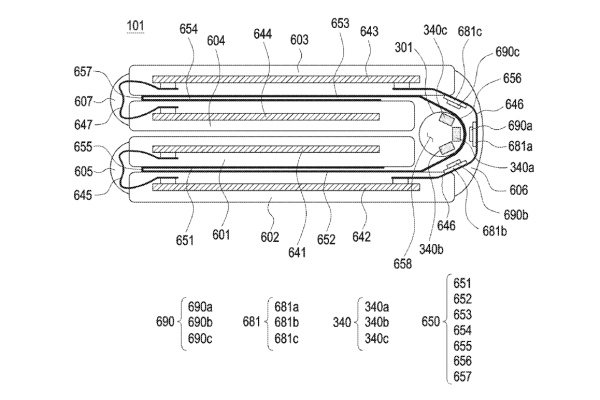
PhoneArena, an IT media outlet, reported on May 11 local time that the patent drawings keep the existing tri-fold structure that folds three times, while adding a design that uses space inside the hinge to store an S Pen.
The drawings largely retain the existing tri-fold structure, which supports a tablet-sized screen that includes a main display and a cover display. They newly add a dedicated space on one side of the hinge to store an S Pen and a method that uses an electromagnet to hold the stylus in place. The design detects the stylus position with sensors to prevent interference during folding, and automatically releases the magnetic hold when users unfold the device.
The patent appears to be an attempt to address limitations of the first-generation tri-fold. The first-generation model drew attention at launch for its ultra-high price of $2,899.99, or about 4.34 million won, but one user complaint was the lack of an S Pen. It was seen as disappointing for consumers who expected handwriting and productivity features as the screen expanded to a tablet-level size. Samsung is interpreted as reflecting such feedback by seeking to improve S Pen usability in a follow-up model.
It is still uncertain whether the patent will lead to an actual product. Companies often file patents to protect ideas without commercialising them. Still, as the first-generation tri-fold recorded strong initial demand, including selling out within minutes of its U.S. launch, Samsung cannot completely rule out the possibility of releasing a follow-up model.
Price and profitability remain key issues. An analysis said the first-generation tri-fold incurred losses on sales due to high production costs. If memory cost burdens and the new S Pen storage technology are added, the selling price of the next model could also exceed $3,000, or about 4.5 million won. Industry officials see Samsung's ultra-premium experiment continuing, noting that if it maintains a limited-supply strategy, premium consumers with strong demand to try the device could still buy it despite the high price.
Ultimately, the key points to watch for the Galaxy Z Tri Fold 2 can be summarised in two parts. One is whether the patent design will lead to actual product development. The other is whether a follow-up model, including S Pen support, can meet user demands while absorbing high costs and prices. If a follow-up model is released, it will test both efforts to address first-generation weaknesses and strategy in the ultra-premium foldable smartphone market at the same time.
 Jinju Hong
hongjj@d-today.co.kr
Jinju Hong
hongjj@d-today.co.kr