
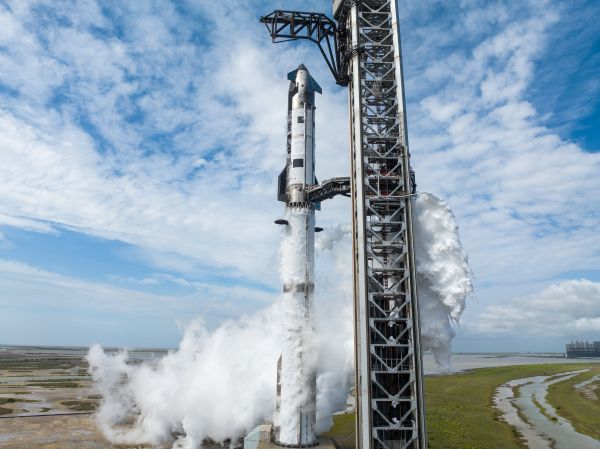
SpaceX fully assembled its 124-metre Starship V3 for the first time, rewriting the record for the tallest rocket ever built.
On May 12 (local time), foreign media including the IT outlet Ars Technica reported that the vehicle is a new model that is larger than the existing Starship and has stronger thrust. It is preparing for a test flight that is set to be a key turning point in SpaceX’s next-generation spacecraft operations plan.
Starship V3 was first raised at the Starbase launch site in south Texas with the upper spacecraft joined to the Super Heavy booster. The total height is 408 feet, about 124 metres, which is 1.2 metres taller than the previous version. SpaceX has been breaking the record for the tallest rocket in the past three years across three occasions, and it again rewrote the world record for the tallest rocket this time.
The core changes are in the propulsion system and the reuse structure. The Super Heavy booster and the Starship upper stage carry Raptor engines with higher thrust and efficiency. A lattice-like reusable structure was added to the top of the booster for hot staging, and the grid fins used for first-stage recovery were reduced to 3 from 4. SpaceX aims to improve first-stage recovery and reuse efficiency through these upgrades.
Launch preparations are also moving quickly. On May 6 it completed a static-fire test that ignited all 33 Raptor engines on the booster at the same time. This was the first time the full configuration of the performance-improved Raptor 3 was ignited in a real test. It then completed the first full assembly on May 10, and on May 12 conducted a fueling rehearsal that injected more than 11 million pounds, about 5 million kg, of supercooled methane and liquid oxygen in two stages.
Liftoff thrust is expected to be about 18 million pounds, about 8.2 million kg, and is about 10 percent higher than the previous-generation Super Heavy based on specifications released by SpaceX. The vehicle is also larger. In V3, the internal transfer pipe that sends methane fuel from the top of the booster to the engine section has a diameter of about 3.7 metres, similar in size to the first stage of the Falcon 9.
This flight will also be the first liftoff from Starbase’s new launch pad. The new launch pad is about 300 metres west of the existing launch point. It will be the 12th Starship test flight overall and the first since October last year. SpaceX has faced schedule delays while preparing the first launch of V3.
The flight path also differs in part. The upper spacecraft aims to make a controlled splashdown in the Indian Ocean about 1 hour after launch, and future V3 flights plan to attempt returning Starship to Starbase to be caught by the launch tower’s mechanical arms. SpaceX has already demonstrated this recovery method with the Super Heavy booster. The flight path was adjusted south of the Gulf of Mexico to pass between the northeastern coast of the Yucatan Peninsula and the western tip of Cuba. It chose a more southerly route instead of the previous Florida Straits path.
V3 is viewed as a turning point beyond a simple test and toward real space missions. SpaceX plans to begin on-orbit refuelling tests with this version. The technology is essential for flights beyond low Earth orbit and, in the short term, becomes a key foundation for serving as a lunar lander under the U.S. space agency NASA’s Artemis programme.
NASA selected Starship and Blue Origin’s Blue Moon as crewed lunar landers for the Artemis 3 and Artemis 4 missions. Artemis 3 targets an Earth-orbit test in mid-2027, and Artemis 4 aims for a lunar landing in late 2028, and both missions depend on whether V3 succeeds.
Links with Starlink are also in focus. Starlink V3 satellites can be launched only with the V3 Starship, and each launch is expected to add 60 Tbps of capacity.
The successful V3 assembly is a tangible milestone showing SpaceX’s technology roadmap is progressing as planned. Some also say that from an investor standpoint, flight verification has not yet been achieved and the valuation is at a historically unprecedented level, meaning technological achievements and investment value should be judged separately.
Launch rehearsal complete. During a flight-like countdown, more than 5,000 metric tonnes (11+ million pounds) of propellant were loaded on the fully stacked Starship and Super Heavy V3 vehicles for the first time pic.twitter.com/e9oZlzc0yz
 Seungah Yoo
ysah@d-today.co.kr
Seungah Yoo
ysah@d-today.co.kr