
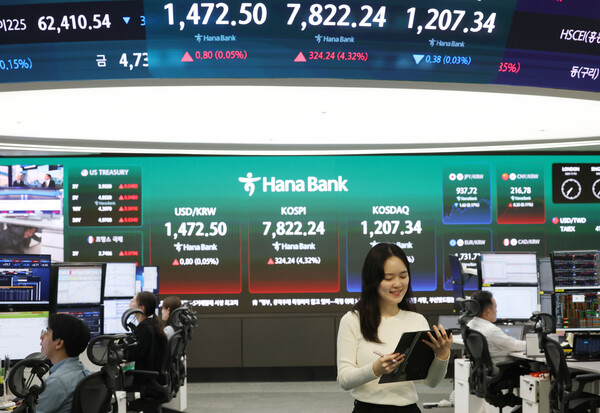
KOSPI has neared the 8,000 level amid a record rally, but Kosdaq continues to show a relatively sluggish trend. As the market remains driven by large blue chips and the returns gap between the two markets widens, expectations for a Kosdaq overhaul and the adoption of a promotion and relegation system are emerging as factors that could spur a rebound.
South Korean stocks closed lower on May 12 as fatigue from sharp gains and foreign selling pressure combined. KOSPI ended at 7,643.15, down 179.09 points, or 2.29 percent, from the previous session. It climbed as high as 7,999.67 early in the session to approach 8,000, but later turned lower. Kosdaq also ended down, closing at 1,179.29, down 28.05 points, or 2.32 percent, from the previous session.
The pullback came as the burden of a short-term surge grew. KOSPI rose quickly led by major sectors such as large semiconductor stocks, financial shares, and shipbuilding and defence, but on Kosdaq gains failed to spread broadly beyond certain themes.
By the day's index declines, both markets were weak. But the accumulated returns gap so far this year shows Kosdaq's relative sidelining.
While KOSPI surged 30.61 percent in April, Kosdaq rose only 13.30 percent. As of April 30, the relative strength ratio of KOSPI divided by Kosdaq hit a record high of 5.53 times. With the large-cap rally on KOSPI continuing, the perceived gap with Kosdaq has widened.
Behind Kosdaq's weakness are differences in earnings and flows. KOSPI's profit outlook improved rapidly, centred on large semiconductor stocks such as Samsung Electronics and SK Hynix.
In contrast, on Kosdaq investor sentiment concentrated on certain sectors such as biotech, secondary batteries and robotics, and the pace of earnings improvement across the broader index was relatively weaker.
Brokerage firms analysed that Kosdaq has underperformed KOSPI by more than 60 percentage points over the past year, the widest gap since 2000. They also viewed the gap itself as a factor that is increasing interest in Kosdaq.
Policy is at the core of expectations for a rebound. The government and the Korea Exchange are reviewing the introduction of a segment system that divides the Kosdaq market into three leagues: premium, standard and a managed group.
Companies would be promoted to an upper league or relegated to a lower league depending on factors such as size, results and corporate governance. The plan's key aim is to separate weak companies into the managed group to raise market trust.
The market views the scheme as a "Kosdaq first-division promotion-relegation system". For the premium league, which would correspond to the first division, a plan is being discussed to place quality firms with financial soundness and growth potential there and use them as the basis for a benchmark index and exchange-traded funds (ETFs).
The Korea Exchange said, "We are currently conducting analysis and review for the introduction of segments, and details such as the timing of introduction and the number of companies in the segments have not been decided."
Jinhyuk Kang (강진혁), an analyst at Shinhan Securities, explained that the plan seeks to create a market structure tailored to company characteristics by dividing Kosdaq into premium, standard and a managed group. He expected the premium segment to include roughly 80 to 170 large, mature companies based on market capitalisation, financials and corporate governance, among other factors.
The goal of introducing a promotion-relegation system is less about simply boosting an index than about clearly defining a pool of investable Kosdaq blue chips. Currently, early-stage growth companies, mature companies and firms at risk of weakness are mixed within the same Kosdaq market.
This has led to criticism that institutional investors and pension funds find it difficult to view Kosdaq as a whole as a long-term investment target. If a premium league is introduced, institutions and passive money may find it easier to access Kosdaq blue chips.
The role of the standard market is also important. A separate plan is being discussed to create linked products such as dedicated indexes and ETFs so that mid-sized and smaller listed companies that are not included in the premium league are not left out. This can be seen as a device to ease the concentration of funds only in the first division and broaden flows across Kosdaq overall.
Korea's business development companies (BDCs) and Kosdaq active ETFs are also cited as factors that could expand flows into small and mid-cap shares. The view is that synergy could be created in discovering promising small caps and attracting flows, because BDCs could be allowed to invest in Kosdaq stocks with market capitalisation of 200 billion won or less and Kosdaq active ETFs target the overall Kosdaq market rather than the Kosdaq 150.
Still, it is difficult to conclude that Kosdaq will see a sustained rebound based on policy expectations alone. The Kosdaq 150 has a high weighting in certain sectors such as biotech, semiconductors, secondary batteries and robotics. The Kosdaq 150 is skewed toward biotech, semiconductors, secondary batteries and robotics, and 7 of the top 10 stocks by market value were in the biotech sector. If earnings or investor sentiment in a specific sector wavers, the structure could increase volatility for the overall index.
Ultimately, a Kosdaq rebound depends on whether the promotion-relegation system and policy-linked products lead to actual inflows of funds. After KOSPI's sharp rise, the burden of large-cap crowding has increased, leaving room for sector rotation into Kosdaq.
But for Kosdaq to move beyond being simply a market that has "risen less" and to emerge as a new leading market, improved earnings, institutional flows and the discovery of small and mid-cap shares must be confirmed together.
Daun Jung (정다운), an analyst at LS Securities, said, "Kosdaq can be expected to benefit from the government's stock market revitalisation policy," adding, "The introduction of segments and the launch of a premium benchmark index ETF are factors that raise expectations for inflows into Kosdaq."
 Sangyeob Oh
yub@d-today.co.kr
Sangyeob Oh
yub@d-today.co.kr