
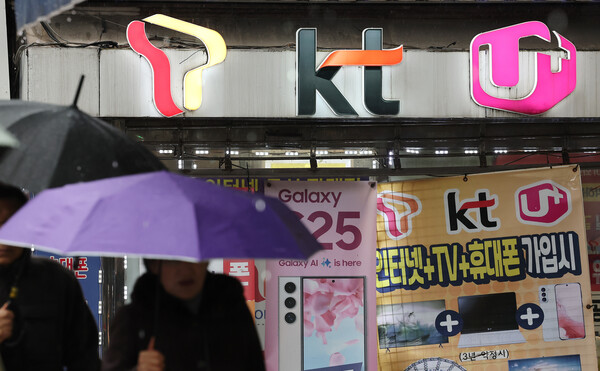
South Korea's three mobile carriers posted different report cards for the first quarter this year. LG Uplus improved results on balanced growth across all business areas, including its artificial intelligence (AI) data centre (AI DC) business.
SK Telecom rebounded on improved profitability in its AI business and a recovery in its wireless business after overcoming a hacking incident. KT's profitability weakened despite expanding its AI transformation (AX) business and improving performance at group affiliates, as a base effect from one-off property sales and the impact of customer compensation costs weighed.
LG Uplus, AI DC growth accelerates... balanced growth across all businesses
LG Uplus posted first-quarter consolidated revenue of 3.8037 trillion won and operating profit of 272.3 billion won. Revenue rose 1.5 percent and operating profit gained 6.6 percent from a year earlier, making it the most stable improvement trend among the three carriers. The company explained that balanced growth across mobile, smart home and corporate infrastructure, along with return-on-investment-focused cost management, helped improve performance.
In particular, revenue from the AI DC business in the corporate infrastructure segment rose 31.0 percent from a year earlier to 114.4 billion won. Total revenue for the corporate infrastructure segment grew 6.3 percent to 435.6 billion won. Analysis said expanding beyond a colocation-focused business into a structure spanning design, build and operate (DBO) led to improved profitability.
Its core telecom business also maintained a stable 흐름. Mobile revenue rose 3.2 percent from a year earlier to 1.6526 trillion won, supported by an increase in subscriber lines. Total subscriber lines were tallied at about 30,931,000. 5G handset subscribers rose to 9,473,000, and 5G penetration among total handset subscribers stood at 84.2 percent.
Revenue in the smart home segment grew 4.1 percent to 656.3 billion won, helped by an increase in gigabit internet subscribers. Its IPTV business also continued to add subscribers by strengthening service competitiveness based on generative AI.
LG Uplus plans to accelerate the expansion of new AI-based businesses and strengthen its company-wide AX strategy. It also plans to expand AX-based automation not only at customer touchpoints but across internal operations to improve operating efficiency.
SKT, AI monetisation gains... wireless subscribers recover
SK Telecom posted first-quarter consolidated revenue of 4.3923 trillion won and operating profit of 537.6 billion won. Revenue fell 1.38 percent and operating profit slipped 5.25 percent from a year earlier, but it showed a clear recovery from the previous quarter. Assessments say it succeeded in rebounding on improved AI profitability and a recovery in its wireless business after overcoming last year's SIM hacking incident. The company explained that making its AI business more efficient based on a selection-and-focus strategy led to improved profitability.
Its wireless business also showed signs of recovery. It achieved a net increase of about 210,000 mobile phone subscribers in the first quarter. Mobile service revenue rose 1.7 percent from the previous quarter. Analysis said a recent membership overhaul and a strategy to diversify pricing plans had a positive effect on expanding subscribers.
It will avoid excessive marketing competition. SKT said, "By operating the business with a focus on profitability, we will continue to strengthen our fundamental competitiveness, and market share will naturally increase," adding, "In line with this stance, we will refrain from competition that spends wasteful costs simply to increase the number of subscribers."
The AI DC business, a key growth engine, posted first-quarter revenue of 131.4 billion won, up 89.3 percent from a year earlier. Rising demand for GPUaaS (GPU-as-a-Service) and higher utilisation at AI data centres drove improved performance. SK Broadband, which oversees the wireline business, posted higher revenue of 1.1498 trillion won and operating profit of 116.6 billion won, up 3.2 percent and 21.4 percent, respectively, from a year earlier, helped by growth in high-speed internet.
KT, profitability slows despite AX expansion... focus on restoring customer trust
KT posted first-quarter consolidated revenue of 6.7784 trillion won and operating profit of 482.7 billion won. Revenue fell 1.0 percent and operating profit dropped 29.9 percent from a year earlier. A high base effect from one-off gains related to property sales last year, along with customer reward programmes and the reflection of costs related to security incidents, affected the slowdown in profitability.
Its core wireline and wireless businesses still maintained growth. Wireless service revenue rose 0.4 percent from a year earlier, and wireline business revenue rose 0.8 percent on subscriber growth. Internet business revenue grew 1.8 percent from a year earlier. Media business revenue rose 1.3 percent on higher IPTV subscribers and increased use of premium set-top boxes.
The enterprise services segment declined due to the end of large build projects, but it said it secured AICC and cloud orders in the financial sector, laying a foundation for future growth. KT is accelerating the expansion of its AX business based on cooperation with global companies such as Microsoft and Palantir.
Performance at group affiliates held up relatively well. KT Cloud maintained a stable revenue 흐름 on rising demand for AI and cloud services. KT is pushing to build AI data centres with a capacity of 500 MW within 5 years. It expects KT Cloud revenue to grow at a double-digit rate.
KT Estate improved performance on expanded property sales and a recovery in its hotel business. K Bank also strengthened its growth foundation by completing its KOSPI listing.
KT is also focusing on restoring customer trust by launching a Customer Protection 365 task force and operating an AI-based real-time detection system and customer compensation programmes.
Carriers shift competitive axis to AI... shareholder returns also strengthened
The industry sees the key competitive point among the three carriers this year as whether AI businesses can be monetised. This is because growth in the existing mobile telecom market has slowed, while the AI DC and enterprise AX markets are emerging as new growth engines.
LG Uplus is strengthening competitiveness in its corporate infrastructure business by expanding AI DC and DBO businesses. SKT is pursuing a 'full-stack AI' strategy that provides AI infrastructure, models and services in an integrated way, and recently created an enterprise integration organisation directly under the CEO to accelerate its push into the enterprise AI market. KT is also stepping up AX platform business based on cooperation with global big tech companies.
An industry official said, "The competitive landscape is now shifting beyond attracting telecom subscribers to competition centred on AI infrastructure and AX businesses," adding, "There is a strong possibility that companies that can generate stable profits in AI data centres and the B2B market will secure a mid- to long-term competitive edge."
The three carriers are also strengthening shareholder return policies. LG Uplus will retire all treasury shares worth about 80 billion won that it has bought since last year on May 15. LG Uplus also retired treasury shares worth about 100 billion won in book value in August last year.
SKT will resume quarterly dividends. The first-quarter dividend is 830 won per share, in line with usual levels. It will decide the annual dividend size when results become clearer, taking into account management performance and its financial structure. KT presented a minimum annual dividend of 2,400 won per share for this year. Its first-quarter dividend is 600 won per share.
The combined first-quarter consolidated operating profit of the three carriers was 1.2926 trillion won. That was down 14.5 percent from 1.5116 trillion won in combined operating profit in the first quarter of last year.
 Jin-ho Lee
jhlee26@d-today.co.kr
Jin-ho Lee
jhlee26@d-today.co.kr