
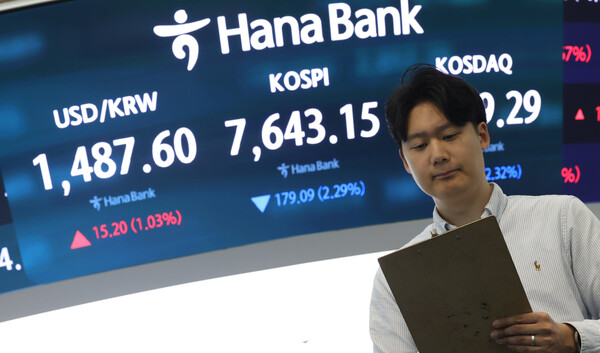
South Korea's KOSPI on Monday climbed as high as just below 8,000 intraday before tumbling to the 7,600 level. Kim Yong-beom (김용범), policy chief at the presidential office, said the benefits of the AI era should be returned to the public as a national dividend, and the market interpreted the remarks as highlighting policy uncertainty as foreign selling intensified.
The KOSPI closed down 179.11 points, or 2.29 percent, at 7,643.13 from the previous session. The index opened at 7,953.41 and rose to as high as 7,999.67, but then turned lower and at one point slid to the 7,400 level.
By investor type, individuals bought a net 6.6602 trillion won, while foreigners and institutions sold a net 5.646 trillion won and 1.155 trillion won, respectively. Foreign selling grew rapidly, widening the index's decline. Institutions also shifted from net buying to net selling in the afternoon.
Most top market-cap stocks ended weaker. Samsung Electronics fell 2.28 percent to 279,000 won and SK Hynix dropped 2.39 percent to 1,835,000 won.
Elsewhere, SK Square fell 5.14 percent, LG Energy Solution lost 5.34 percent, Doosan Enerbility slipped 1.87 percent and Samsung C&T fell 3.76 percent.
HD Hyundai Heavy Industries rose 3.21 percent and Samsung Electro-Mechanics gained 6.44 percent. Hyundai Motor ended flat.
The KOSDAQ closed down 28.05 points, or 2.32 percent, at 1,179.29.
In the Seoul foreign exchange market, the won ended at 1,489.20 per dollar, down 14.20 won.
Bloomberg reported that a South Korean policy official mentioned a plan to return tax revenue generated by the AI industry to the public, as South Korean stocks showed high volatility.
Bloomberg said his Facebook post triggered extreme volatility in South Korean stocks, explaining that confusion grew as investors tried to interpret what policy the proposal would actually mean.
Earlier, Kim wrote on his Facebook that if a strategic position in the AI infrastructure supply chain creates a structural boom and leads to record excess tax revenue, how to use that money is not a matter of choice but an issue that must be considered.
He added that the benefits came on a foundation built together by all citizens over half a century, and argued that part of the benefits should be structurally returned to the public.
 Sangyeob Oh
yub@d-today.co.kr
Sangyeob Oh
yub@d-today.co.kr