
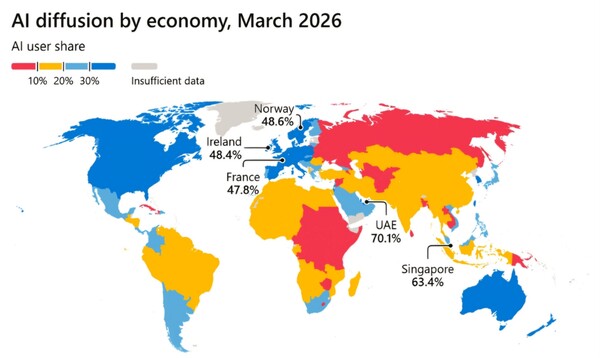
[DigitalToday reporter Chi-gyu Hwang (황치규)] Microsoft think tank the AI Economy Institute released findings from an AI diffusion report, publishing analysis of industrial change centred on the digital divide and software development.
The Global AI Diffusion Q1 2026 Trends and Insights report said the share of the global working-age population that used generative AI in the first quarter of 2026 rose 1.5 percentage points to 17.8 percent from 16.3 percent.
The number of countries where generative AI use exceeded the 30 percent threshold rose to 26 from 18 in the previous quarter. By country, the United Arab Emirates (UAE) hit 70.1 percent to become the first in the world to top 70 percent, followed by Singapore at 63.4 percent, Norway at 48.6 percent, Ireland at 48.4 percent and France at 47.8 percent. The United States rose to 31.3 percent from 28.3 percent and moved up to 21st from 24th.
South Korea posted 37.1 percent, up 6.4 percentage points from the previous quarter, marking the steepest growth in the world. Its global ranking rose to 16th from 18th.
The report explained that the momentum is a representative example showing an Asia-wide diffusion pattern. It found that 12 of the 15 fastest-growing markets are in Asia. It cited long-term investment in digital infrastructure, national-level AI strategies, high consumer acceptance, improved performance of major models in Asian local languages, and the ability to quickly integrate new technology into daily life and economic activity as factors behind the growth.
Imbalances between regions deepened further. The report said the usage gap between the advanced-economy-focused Global North and the emerging-economy-focused Global South continues to widen. In the first quarter of 2026, the Global North's generative AI usage rate was 27.5 percent, up 2.8 percentage points from the second half of 2025, while the Global South rose 1.3 percentage points to 15.4 percent.
The report pointed to structural limitations in the Global South as a backdrop to the gap. It cited infrastructure gaps, including power supply, internet connectivity and a lack of digital capabilities, as key factors.
Technically, stronger local-language support and expanded multimodal interaction capabilities were cited as major drivers of diffusion. In particular, it said performance gains in non-English languages, confirmed in multilingual benchmarks such as MMMLU that evaluates the same knowledge tasks in 14 languages, have enabled AI tools to handle multilingual work more effectively.
As a result, accessibility improved for everyday use cases such as messaging, search, learning and content creation. The analysis said these changes, combined with widespread smartphone adoption and high digital participation, enabled faster diffusion across both advanced and emerging countries in Asia.
User demand and workplace adoption also accelerated. A McKinsey study found AI use in Southeast Asia is progressing faster than the global average, and many organisations are moving beyond the pilot stage into scaled deployment. The Stanford HAI Index indicated positive perceptions of AI in places such as Thailand and Turkey and suggested openness and demand are likely to remain steady.
The expanding influence of AI in software development was also clear. Coding-focused systems from major companies such as Anthropic and OpenAI showed the ability to handle complex engineering tasks.
The report said it is still too early to draw conclusions about the impact of AI coding on the overall labour market. It added that current data show a trend consistent with productivity gains and the possibility of rising demand for software development. It explained that higher developer productivity leads to lower software build costs, which can allow companies to expand the scope of software adoption to more diverse use cases.
The report is based on aggregated, de-identified Microsoft telemetry. It was calculated with adjustments to reflect operating system and device market shares, internet penetration rates and differences in national population size. It also measured the share of the global working-age population aged 15 to 64 that used generative AI products during the survey period.
The Microsoft AI Economy Institute is continuously refining its method of measuring global AI diffusion to more accurately reflect differences in country-level usage patterns. The report used cross-country comparison indicators available at present and said it plans to supplement them as additional indicators are developed and data accumulate.
 Chi-gyu Hwang
delight@d-today.co.kr
Chi-gyu Hwang
delight@d-today.co.kr