
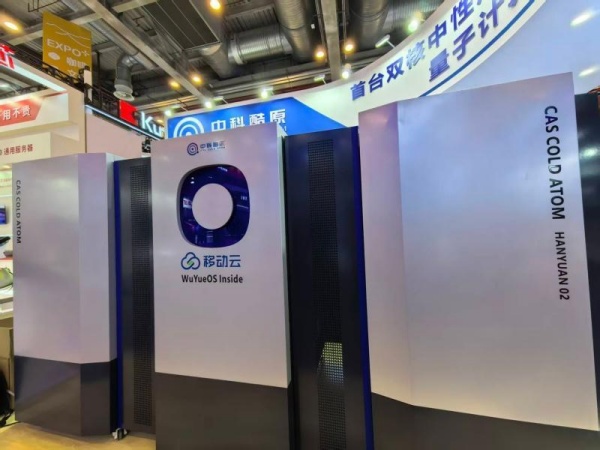
[DigitalToday reporter Jinju Hong (홍진주)] China unveiled a 200-qubit neutral-atom quantum computer called Hanyuan-2 (Hanyuan-2), claiming it has implemented the world’s first “dual-core” quantum computing structure. Key performance metrics and a peer-reviewed paper have not been released, leading some to say it is too early to judge its competitiveness.
On May 11 local time, online media outlet Gigazine reported that Wuhan-based Zhongke Kuyuan, a company under the Chinese Academy of Sciences, announced the neutral-atom quantum computer Hanyuan-2 on May 7.
Hanyuan-2 is built with two neutral-atom arrays that operate independently inside a single rack-sized unit. It uses 100 rubidium-87 atoms and 100 rubidium-85 atoms, for a total of 200 qubits.
The company described it as the “world’s first dual-core cooperative computing structure.” It said the two arrays each function like an independent quantum processor, allowing a task to be split and processed in parallel, or enabling one array to handle real-time error correction while the other performs computation.
Zhongke Kuyuan Technology said the design aims to reduce qubit scaling limits seen in single-core quantum processors and to mitigate interference between adjacent qubits.
The company also highlighted installation conditions and power efficiency. It said Hanyuan-2 operates with only a small laser-cooling system, without complex cryogenic equipment, and can be installed relatively quickly in a standard indoor environment. Total power consumption is said to be less than 7 kW.
A senior researcher at Zhongke Kuyuan Technology said, “It is the world’s first time a quantum processor has evolved from a single-core to a dual-core structure,” calling it an “independent breakthrough” in core quantum-computing architecture.
The neutral-atom approach uses lasers to trap and cool atoms that carry no electric charge, then controls each atom as a qubit. It is promoted for long coherence times, high scalability and stable operation, and is considered one of the major next-generation quantum computing paths alongside superconducting and ion-trap approaches.
Zhongke Kuyuan Technology CEO Tang Biao said Hanyuan-2 has more than 500 optical-tweezer array sites and a qubit lifetime of about 100 seconds. He said some key performance is already at the level of international leaders.
Industry sources also urged caution, saying it remains difficult to assess real performance. While the company disclosed qubit count, power consumption and structural features, it did not release key benchmarks such as quantum gate fidelity, error rates and detailed coherence performance. No peer-reviewed paper has been published so far.
There is also a gap in disclosed information compared with competitors. U.S.-based Atom Computing has demonstrated a neutral-atom array with 1,180 qubits in 2023 and later entered a phase of developing error-corrected logical qubits in cooperation with Microsoft. Another neutral-atom company, QuEra, has supplied an error-correction-capable system to Japan’s National Institute of Information and Communications Technology and has released key performance indicators such as quantum gate fidelity and error rates.
Industry sources said Hanyuan-2’s dual-core structure, its main point of differentiation, also needs further verification. They said integrating two neutral-atom arrays densely inside a single unit is meaningful, but it has not yet been confirmed whether it offers advantages in scalability and efficiency over a large single-array approach.
Ultimately, experts say benchmark data and external verification results released in the future will be the key criteria for judging Hanyuan-2’s real competitiveness.
 Jinju Hong (홍진주)
hongjj@d-today.co.kr
Jinju Hong (홍진주)
hongjj@d-today.co.kr