
The agentic AI era is approaching, in which smartphones anticipate users’ intentions and handle tasks on their own. Another meaning of agentic is that AI has moved into the smartphone chip. That allows photos to be retouched, interpretation performed and documents summarised in the palm of a hand, without personal data travelling to external data centres.
How far can it go in real conditions? I used a Galaxy S26 Ultra for 72 hours with airplane mode fixed on. The goal was to see how well only the Snapdragon 8 Elite 5th generation’s NPU, QMX and GPU performed on their own, with the cloud blocked, meaning no internet connection.
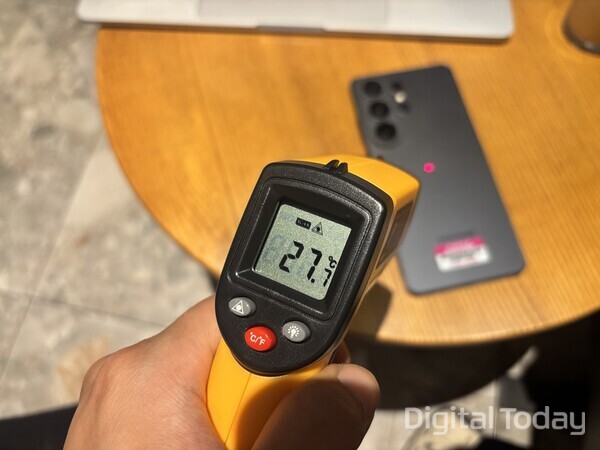
The test compressed 72 hours into three scenarios: daily life, business travel and a weekend. With airplane mode on, it recreated a worker’s day, a traveller’s day with unstable internet, and a day making content over the weekend. Surface temperatures were measured with an infrared thermometer.
Two measurement points were selected. The area below the rear camera module is where the mainboard and application processor sit, and it is where chip heat is transmitted first. The centre of the back is a standard measuring point where the result of the vapour chamber dispersing heat appears on the surface. Response times were recorded with a separate stopwatch, and the same tasks were measured online before entering airplane mode to set a baseline for comparison.
The first day simulated a worker’s day. A series of short, varied AI tasks followed, from converting and summarising 5 minutes of meeting audio, to drafting an email after the meeting, to erasing objects from 3 photos on the way home. A multi-step process combining meeting-audio conversion and summarisation for 5 minutes, done while doing other tasks, took 18.52 seconds, and the surface temperature stayed at 31.6 degrees. Drafting an email based on the meeting content took 2.4 seconds.
Finally, the time taken to erase objects from 3 photos in sequence was exactly the same as the baseline measured online. The surface temperature rose from 32.1 degrees at the start to 32.3 degrees at the end, an increase of 0.2 degrees. Galaxy phones specify for the object eraser function that it "processes images only on the device." The measurements matched that description.
Qualcomm explained that the Hexagon NPU in the Snapdragon 8 Elite 5th generation for Galaxy improves performance by 39 percent from the previous generation, and that the QMX engine integrated into the CPU handles lightweight AI inference. The short, frequent work pattern of the daily-day scenario is an area suited to splitting processing between the NPU and QMX engine. The measurements showed no reliance on the cloud.
◆Galaxy S26 Ultra 72-hour report, enduring daily life, business travel and weekend
The second day assumed an overseas business trip with unstable internet. It translated 6 photos of foreign-language menus and signboards and simulated 10 Korean-English interpretation pairs. A multi-step task also followed that summarised an English business email in Korean and then automatically translated the reply into English. Translating foreign-language photos took an average of 2.3 seconds per image.
Despite multi-step processing combining image recognition and text translation, surface temperature rose only 0.6 degrees, from 32.1 to 32.7 degrees. The 10 Korean-English interpretation pairs returned responses in an average of 1.5 seconds per sentence, and the temperature was up 0.4 degrees after the task ended. The multi-step task linking English-email summarisation and automatic translation of the reply also finished in a combined 4.2 seconds. The range of heating was not much different from the daily-day scenario.
The Snapdragon 8 Elite 5th generation is designed to divide processing roles by the nature of the work. The NPU handles heavy AI models, the GPU handles graphics tasks, and the CPU and QMX engine share lightweight inference. With work not concentrated in one unit, responses do not cut out even during multitasking. Running photo retouching at the same time with interpretation mode on did not stop tasks. After leaving the device idle for 30 minutes, surface temperature returned to its original state. A new vapour-chamber structure cooled accumulated heat quickly.
The third day, the weekend, was set as a content creator’s day. The chip was most candid on this day. Recording a 1-minute video 3 times in a row with the APV 8K codec raised surface temperature from 29.4 degrees at the start to 33.2 degrees, a 3.8-degree increase. It was the largest rise in the 72-hour measurements.
A notable point was that in a 4K H.265 1-minute, 3-time shoot conducted right after, temperature instead fell 0.2 degrees, from 29.6 to 29.4 degrees. That suggests the APV codec demands a different level of chip load from other codecs. Subsequent APV video editing, which included AI tasks such as separating crowd noise and amplifying voices, raised temperature by only 0.2 degrees.
Qualcomm explained that APV enables cinema-grade video processing through dedicated hardware encoding and decoding. The measurements supported that explanation. At the same time, they showed that APV is the heaviest load carried by a mobile chip. It is a paradox in which the true cause of chip load is video codecs, not AI tasks.
◆A split-processing structure with no response dropouts even in multitasking
In the 72-hour test, simple AI tasks produced almost no heat. Multi-step AI tasks also showed only slight rises of less than 1 degree. Only video codec processing made the chip notably hot, but even then it returned to normal in under 30 minutes. After all measurements, battery consumption was less than 10 percent. Even accounting for the power-saving effect of airplane mode, it shows mobile application processors have reached a considerable level of power efficiency.
Because the results are based on compressed measurements of a single device over 1 day, there are limits to generalisation. Still, the Galaxy S26 Ultra, which endured airplane mode for 72 hours while moving through daily life, business travel and weekend scenarios, left the impression of being the first generation to meaningfully reduce reliance on the cloud. The task for the next generation of mobile application processors is now more likely to shift toward distributing video codec load than reducing heat.
The test shows that mobile AI is moving past an era of relying on the cloud. It is shifting from a structure in which commands went to data centres for answers to one in which the chip directly receives and processes commands. It signals that the starting point of the agentic AI era is not data centres but the palm of a hand. Competition over NPUs in mobile chips is also more likely to become the battleground for next-generation smartphones.
 Dae-geon Seok
d2dg@d-today.co.kr
Dae-geon Seok
d2dg@d-today.co.kr