
As logistics innovation combining electrification and autonomous driving spreads rapidly in China, uncrewed logistics systems are entering the commercial stage from urban delivery to long-haul trunk transport.
CleanTechnica, an electric-vehicle-focused outlet, reported on May 8 that uncrewed logistics vehicles known as “robovans” are expanding in major Chinese cities, replacing conventional delivery vans. It also said the rollout of Level 4 (L4) autonomous trucks is gaining pace in long-haul freight transport.
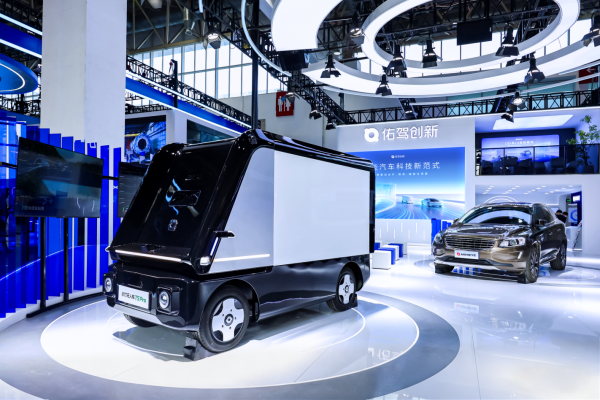
At the recently held Beijing auto show, various robovan models were unveiled, underscoring intensifying competition for commercialisation. Built on electric-vehicle platforms, they apply L4 autonomous driving technology and are designed to carry cargo without a driver.
Chinese autonomous driving company MINIEYE unveiled its latest model, the Bamboo Robovan T5 Pro. The company introduced it as the industry’s first “true mapless L4 uncrewed logistics vehicle” and said it was designed to reduce reliance on high-precision maps so it can be deployed immediately in a range of areas.
The vehicle is equipped with MINIEYE’s intelligent driving system, iPilot 4 Max. Earlier models are currently operating in 18 Chinese cities. The new model involved multiple partners during development, and deliveries are set to begin within months.
Another autonomous driving company, QCraft, also unveiled an L4 robovan, joining the competition. Founded by former Waymo employees, the company stresses a “full-stack autonomous driving system” based on a data closed loop while reducing reliance on map-based systems. It also presented a structure that uses small robots to support cargo loading, raising last-mile delivery efficiency.
Key specifications for the robovans on display include about 5 cubic metres of cargo space and about 1,000 kg of payload. A key feature is the removal of the driver’s seat to maximise space utilisation. Range is set at about 200 km, optimised for city delivery-focused operations. Pricing is presented at under $20,000, and analysis has also emerged suggesting investment payback can be rapid through labour cost savings.
In large-scale logistics, Carl Dynamics unveiled its L4 autonomous truck, KargoBot Space, as it moves to expand commercial operations. The vehicle is a semitruck-class freight truck with a fully uncrewed structure, removing the conventional cab layout to improve loading efficiency.
KargoBot said it has recorded transport performance of more than 1.4 billion ton-km so far. It said the new model expands cargo space by about 25 percent and improves effective transport capability by 10 percent. Working with battery company CATL, it adopted a battery-swapping method and says it can drive autonomously up to about 2,000 km a day.
China already has a rail-based mass transport system, but there are still segments where truck-based logistics remain dominant. As a result, logistics solutions combining electric vehicles and autonomous driving technology are spreading rapidly in both urban delivery and long-haul transport.
The industry is also being assessed as having moved beyond simple technology demonstrations into competition over operational efficiency. In particular, as the pace of commercial deployment for autonomous logistics vehicles accelerates, the possibility is being raised that it could affect future changes in the global logistics structure.
 Jinju Hong
hongjj@d-today.co.kr
Jinju Hong
hongjj@d-today.co.kr