
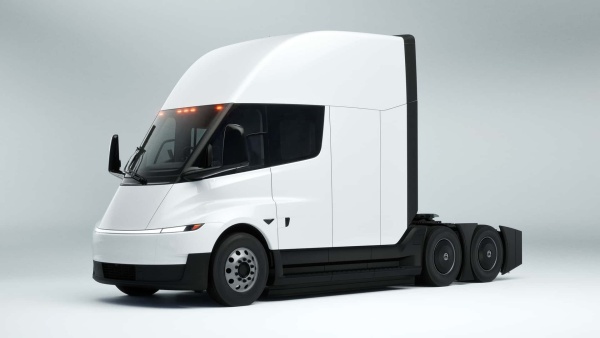
[DigitalToday reporter Jinju Hong (홍진주)] The actual battery capacity of Tesla’s Semi electric truck has been confirmed through official documents. The battery is smaller than estimates at the time of its initial unveiling, but its driving range is unchanged, drawing attention to efficiency improvements.
Electrek, an electric-vehicle outlet, reported on May 8 that an administrative order document from the California Air Resources Board (CARB) lists the Tesla Semi Long Range and Standard Range battery specifications at 822 kWh and 548 kWh, respectively.
The most closely watched point is battery capacity. Elon Musk said at the Semi unveiling in 2022 that the long-range model with a 500-mile range would have a battery of about 900 kWh. The certification document now confirms the mass-production battery capacity at 822 kWh.
Even so, the long-range Semi maintained the same 500-mile range under a gross weight condition of 82,000 pounds. The industry sees this as the result of Tesla raising vehicle efficiency.
Tesla has presented the Semi’s energy use at about 1.7 kWh per mile, and the recently disclosed improved Semi is reported to be about 1,000 pounds lighter than the initial prototype. The explanation is that body weight reduction, aerodynamic improvements and higher efficiency in the three-motor drivetrain contributed to lower power consumption.
The two models share the same drivetrain specifications. They use an 800 kW-class three-motor system, and continuous output is about 525 kW. Charging supports a 1.2 MW-class Megacharger based on an MCS 3.2 connector.
Compared with rival models, the battery capacity and driving range show an advantage. The Freightliner eCascadia can travel about 230 miles with a maximum 550 kWh battery, and the Volvo VNR Electric can travel about 275 miles with 564 kWh. The Nikola Tre BEV is also at a maximum of about 330 miles. By contrast, the Tesla Semi Long Range delivers 500 miles with an 822 kWh battery.
Electrek said the Semi secured efficiency of about 0.6 miles per kWh, and rated it as higher efficiency than rivals at about 0.4 to 0.5 miles.
The market is also focusing on the strategic value of the standard model. The standard version can travel about 325 miles on a single charge with a 548 kWh battery. The long-range version is known to cost about $290,000 and the standard version about $260,000. With the price gap at about $30,000, forecasts say demand for the standard version could expand more in markets centered on regional logistics.
The battery structure has also been simplified. Tesla applied a modular battery structure, and the standard version was reported to be configured by excluding 1 of the 3 parallel battery modules used in the long-range version. The analysis is that this reduced both battery raw material use and vehicle weight at the same time.
Charging infrastructure is also expanding. Tesla’s Megacharger network is now growing to 66 locations across 15 U.S. states. The installation price, based on a two-post configuration, is about $188,000. The long-range Semi is known to be able to charge to about 60 percent of its battery in about 30 minutes in a 1.2 MW charging environment.
Industry attention is now shifting to the pace of mass production. Tesla has started Semi production at its Nevada plant, while also moving forward with battery certification and charging network expansion. Even so, estimates for deliveries this year vary widely from 5,000 to 15,000 units, and assessments say uncertainty remains over the pace of production ramp-up.
 Jinju Hong
hongjj@d-today.co.kr
Jinju Hong
hongjj@d-today.co.kr