
Telecommunications and broadcasting are part of daily life. Behind them, an unseen technology race and industrial change continue. Shintongbangtong is a series that explains telecommunications and broadcasting technology and market trends in an easy and engaging way. It looks at the context on the ground, from the latest technology and policy to market changes.
[DigitalToday reporter Jin-ho Lee (이진호)] A term frequently heard in the media industry these days is FAST. As an English word it first brings to mind speed, but FAST in the broadcasting market is not directly related to speed.
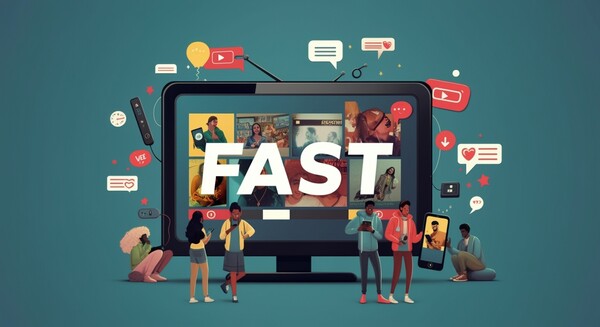
FAST is short for Free Ad-Supported Streaming TV. Put in Korean, it is ad-based free streaming TV. Users watch content without a separate subscription fee in return for watching ads, and platforms and content providers earn revenue from that advertising. In other words, it is internet TV that can be used for free by watching ads instead of paying subscription fees.
One point to remember is that FAST is different from simply watching a free online video service (OTT) or video on demand (VOD). With OTT services such as Netflix, Tving, Wavve and Coupang Play, users choose what they want to watch. They select a drama episode or search for a film and watch it at a convenient time.
FAST works differently, operating like TV channels. Content keeps running on pre-scheduled channels. Users select the channel they want and watch content with ads. Like traditional TV, it keeps the basic framework of channels and scheduling, but delivery is via the internet rather than broadcast networks.
FAST is drawing attention against a backdrop of fatigue with OTT subscriptions. The OTT market has grown quickly over the past few years. But the burden has also increased for users. Content they want to watch is scattered across platforms, requiring separate subscription fees. Subscribing to only 1 or 2 can feel insufficient, but using several together means a significant monthly cost.
In this situation, FAST is emerging as a new option. Paid OTT services are still strong for the latest original content or exclusives. By contrast, content that people put on casually, past hit dramas and entertainment shows, news and sports highlights fit well with FAST. Users can watch without paying, and content providers earn advertising revenue.
In the U.S. market, Pluto TV, Tubi and the Roku Channel are cited as representative FAST services. In South Korea, Samsung TV Plus and LG Channels are leading examples. Samsung Electronics and LG Electronics in particular are growing FAST as both smart TV makers and platform operators.
◆Why Samsung and LG are focusing on FAST
The industry structure needs a closer look. FAST is also a good business model for TV makers. In the past, their core competitiveness lay in screen size, picture quality, price and design. The basic model was to make high-performing TVs and sell more of them. But in the smart TV era, TVs are changing from simple home appliances into internet platforms.
Samsung Electronics and LG Electronics entering the FAST market fits the same context. With just a few clicks on a TV remote, users can immediately watch FAST content. For TV makers, that helps increase the device's appeal. That is because what free channels are available can become a factor in a consumer's TV purchase decision.
The longer users watch Samsung TV Plus or LG Channels, the more advertising revenue is generated and the more viewing data accumulates. It can analyse what genres people watch most, what times they turn on the TV and which channels they stay on for longer.
Samsung Electronics explains that Samsung TV Plus provides more than 100 channels across news, sports, films, music and kids and family content. Samsung TV Plus can be used not only on Samsung smart TVs but also on Samsung mobile devices.
LG Electronics last year revamped its logo and user experience and added region-specific services to mark the 10th anniversary of LG Channels. A representative example in the United States was adding viewing reservations and alerts to an 'Upcoming' feature that previews new content lists. LG Electronics explains it is an essential feature in the United States, where there are many avid sports fans, to avoid missing sports games.
For TV makers, FAST is a channel to open up business beyond device sales. In the past, once a TV was sold, the maker's role largely ended. Now it is different. After a TV is turned on, what home screen a user sees, what apps they launch and what free channels they stay on all become business opportunities. FAST TV screens are becoming platforms that combine content distribution, advertising and data-driven services, beyond being a window that shows broadcasts.
For content providers, FAST is also a new outlet. Broadcasters and producers can reuse dramas, entertainment shows, educational programmes, documentaries and films they already own. Even content after its broadcast ends can gain renewed life if reorganised into a channel format. In the past, reruns after the initial broadcast or VOD sales were the main reuse methods, but through FAST, older content can create new value depending on scheduling and packaging.
For example, a channel can be created that schedules a specific hit drama all day. A channel can also be made that strings together past seasons or memorable scenes of variety shows. Content can also be bundled into channels by theme such as travel, pets, golf, cooking and documentaries. It is not reselling individual titles, but turning a content library into a single channel experience.
◆Also drawing attention as an export channel for K-content
The government is also paying attention to FAST. That is because it is an excellent tool for spreading K-content. The Ministry of Science and ICT last year 추진했습니다 supported a K-FAST expansion programme specialising in artificial intelligence (AI) dubbing. Through the programme, 6 consortia applied localisation technologies such as AI dubbing to K-content. It compiled about 1,400 hours of AI-dubbed content and 20 K-channels. The content will be transmitted to about 20 countries including North America, Central and South America, and Europe through Samsung TV Plus and LG Channels.
This shows FAST is not merely a new revenue model for the industry. It is because K-content can be exposed to overseas viewers in the form of free channels. Accessibility increases especially when dubbing in local languages is combined. It creates a structure in which overseas users can access K-content channels on smart TVs without paying separate subscription fees.
This could also bring change to how K-content is exported. In the past, the main methods were selling content rights, listing on global OTT platforms and distributing YouTube clips. FAST allows 지속적인 continued exposure at the channel level. It could also be a new opportunity for smaller production companies.
FAST is also significant for the advertising market. Traditional TV ads have the advantage of being exposed to many viewers at the same time, but have limitations in granular targeting. FAST, by contrast, is an internet-based service. Based on viewing data linked to smart TVs, it can create more sophisticated ad products. Advertisers can run ads tailored to specific genres or viewing behaviour, and platforms can improve advertising efficiency.
There are also challenges. Being free does not mean users will necessarily stay longer. If there are too many ads or the same ads repeat, fatigue increases. If channel lineups are monotonous and content quality is low, users will quickly leave even if it is free. Ultimately, FAST's competitiveness depends on how well it can create channels worth watching, beyond being free.
AI integration is also expected to expand further. AI dubbing lowers language barriers. Content recommendation AI can place channels that match user preferences at the forefront. AI also plays an important role in providing ads suited to viewing context.
Ultimately, FAST is not just 'free TV'. It is a model that moves broadcasting's long-standing grammar of channels and scheduling into the internet environment, combining smart TV platforms with advertising technology and AI localisation technology. That is why Samsung Electronics and LG Electronics are investing in FAST, and why the government views FAST as a tool to spread K-content.
The broadcasting and content market has always moved with the evolution of technology. Just as it moved from terrestrial to cable, from cable to internet protocol television (IPTV), and again to OTT, viewer choices have continued to widen. The broadcasting and content market is expanding into competition over what screen to show content on, how to show it, and how to monetise it. FAST is 충분합니다 enough to be the next scene. FAST is expanding into an area where broadcasting's channel experience, OTT's internet technology, advertising platforms' revenue models, and AI-based localisation technology are mixed together.
 Jin-ho Lee
jhlee26@d-today.co.kr
Jin-ho Lee
jhlee26@d-today.co.kr