
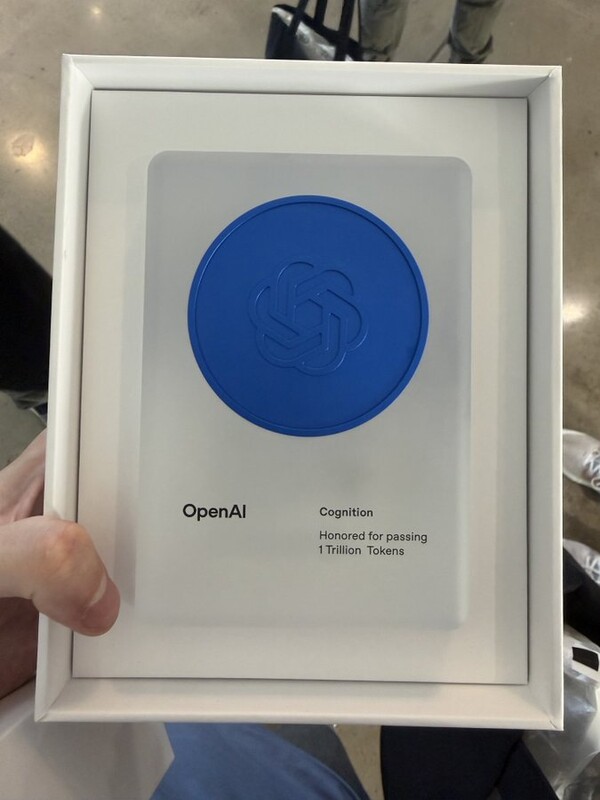
OpenAI has launched a developer ecosystem lock-in strategy by awarding physical prizes to companies that use large volumes of application programming interface (API) tokens. It is continuing an aggressive push into the developer market despite heavy losses.
OpenAI unveiled its Tokens of Appreciation awards program at its developer event DevDay 2025 in October last year. Based on cumulative OpenAI API usage, it awards three tiers of physical aluminium tokens engraved with a company name: 10 billion tokens (silver), 100 billion tokens (black) and 1 trillion tokens (blue). The approach is similar to how YouTube gives creators silver and gold buttons based on subscriber counts. It will continue the program this year by tallying usage through May 31.
There have also been award cases in South Korea. Danggeun received a black token after processing more than 100 billion tokens cumulatively. A Danggeun official explained, "We used many OpenAI models across overall operations and across overall services." Vertical AI solution company Platyter also received a silver token earlier this month. It said it reached that volume through its agentic AI platform XGEN and commerce solution X2B. Platyter CEO Sanghoon Lee (이상훈) said, "It is the result of continuously using AI technology in actual business settings."
An OpenAI Korea official said, "The aim is to bring domestic and overseas developer communities into the OpenAI ecosystem," and added, "OpenAI also views the Korean developer market as a strategic point, and it seems to be drawing attention in connection with recent positive evaluations of Codex."
The token awards are described as a way for the development industry to publicly certify token usage. For companies, it serves as a reference that they have applied OpenAI models at scale in real services and operations, while for OpenAI it has the effect of exposing high-usage customers externally. The more developer and corporate customers become accustomed to a specific model's API, pricing system and operating tools, the higher the switching costs to move to other models.
Winning developer customers is also key in competition with Anthropic. Anthropic's Claude Code, OpenAI's Codex and Anysphere's Cursor are major players. Many assessments still say Claude Code is ahead in the AI coding agent market.
But OpenAI's catch-up is also clear. According to Reuters, Codex usage rose to 40 percent in January this year from about 5 percent of Claude Code in September last year. OpenAI then unveiled GPT-5.3 Codex in February this year and integrated Codex-line performance into GPT-5.4 in March. The dominant response has been that code generation quality and agent execution capabilities have improved.
OpenAI also views the spread of Codex as central to securing developer customers. Last month it expanded cooperation with global consulting firms such as Accenture and PwC, and launched "Codex Labs," deploying OpenAI specialists directly into clients' AX organisations. It is a strategy to lower adoption barriers by embedding Codex into companies' internal development environments.
Still, there is also criticism that it will be difficult to sustain this strategy over a long period. Some analysts believe OpenAI is spending about $2.25 to generate $1 in revenue. That means expanding usage may increase the burden of inference costs rather than improve profitability.
An AI industry expert said, "Just as more than 4 million CUDA developers became Nvidia's moat, the side that pre-empts the developer ecosystem will ultimately dominate the AI market," and added, "As API usage accumulates, prompts, evaluation systems and internal tools become tailored to a specific model, so from OpenAI's perspective it is important to keep customers bound within the ecosystem even if it accepts short-term cost burdens."
 Seulgi Son
sageson@d-today.co.kr
Seulgi Son
sageson@d-today.co.kr