
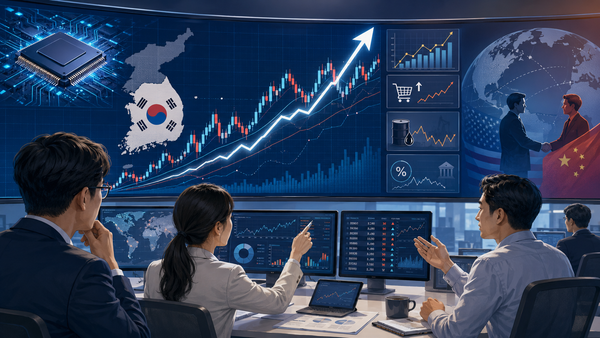
South Korean stocks in the second week of May are expected to look for direction while checking U.S. inflation data, a U.S.-China summit and earnings momentum centered on semiconductors. With the KOSPI nearing the 7,500 level and extending record-high territory, market attention is shifting to a balance between further upside and near-term overheating concerns.
According to the Korea Exchange, the KOSPI rose 13.5 percent last week and the semiconductor sector surged more than 24 percent. The KOSDAQ gained just 0.6 percent, as trading favored large-cap and growth shares.
The industry is citing the U.S. April consumer price index as the first key variable for equities this week. The U.S. CPI is due on May 12 local time.
The U.S. April producer price index is scheduled for May 13, followed by U.S. April import prices and retail sales on May 14. If inflation readings come in higher than expected, upward pressure could increase, led by long-term yields.
Federal Reserve officials have recently kept a rate hold as the base scenario, while showing caution about the possibility of inflation resurging. If oil and commodity prices pass through to consumer prices, expectations for rate cuts could weaken and volatility in growth shares could rise.
Inflation and interest-rate caution also remains in South Korea. April consumer prices rose 2.6 percent from a year earlier due to the impact of a sharp rise in oil prices, while comments from within the Bank of Korea mentioning the possibility of rate hikes rather than cuts pushed up government bond yields. Hawkish caution could persist until the new governor's first Monetary Policy Committee meeting.
The second key variable is the U.S.-China leaders' summit. The meeting, to be held in Beijing on May 14 to 15, is expected to serve as an occasion to check whether tensions in bilateral ties ease.
The industry sees the meeting as a place to coordinate key issues such as trade, supply chains, advanced semiconductor equipment, rare earths and energy security, rather than resolving structural conflicts at once.
May 15 is also the deadline for 13F filings that allow investors to check U.S. institutional investors' first-quarter holdings. If shifts in major asset managers' weightings in technology stocks, energy, financials and exchange-traded funds are confirmed, they could offer clues to gauge global money flows.
Semiconductors remain at the core of South Korean equities. As earnings forecasts for Samsung Electronics and SK Hynix have been revised up quickly, the KOSPI's 12-month forward earnings per share rose to 977.8 points as of May 7.
Another analysis says that even though the KOSPI has entered the 7,000 era, its 12-month forward price-to-earnings ratio remains around 7.6 times.
The industry sees room for further gains even from valuation normalization alone. Applying a forward PER of 8 times puts the KOSPI around the 7,800 level, while 9 times yields up to 8,800. This assumes semiconductor profit forecasts hold and foreign buying and selling does not waver.
In fact, the recent rise in South Korean stocks is heavily dependent on semiconductors. South Korea's stock market capitalization has climbed to $4.53 trillion, up to seventh in the world, with AI semiconductor-related shares such as Samsung Electronics and SK Hynix contributing significantly. The combined market capitalization of the two stocks accounts for a share close to half of the domestic stock market.
But the burden from concentration is also growing. On May 7, foreign investors posted net selling of about 72 trillion won in a single day, the largest daily net sale on record. Given they had net bought more than 60 trillion won over the first 2 trading days of May, it suggests that as the market has grown, flow volatility has expanded as well.
Valuation overheating remains an issue. The Buffett indicator, the ratio of market capitalization to gross domestic product, is in historically high territory in major countries including South Korea, the United States, Japan and Taiwan.
Concerns are also being raised about deterioration in the quality of index gains as the broader global equity rally is concentrated in a small number of semiconductor and AI-related stocks.
Against this backdrop, a key question for South Korean stocks this week is whether rotation broadens while the semiconductor-led trend holds.
If inflation data are confirmed as stable and oil prices settle on progress in U.S.-Iran talks, the rate burden could ease and the chance of a rebound in growth shares that have been held down could rise.
If U.S. CPI and PPI come in higher than expected or conflict factors stand out at the U.S.-China summit, short-term profit-taking pressure could increase. With the KOSPI having surged in a short period, the market is expected to continue focusing less on the index itself and more on the strength of sector-by-sector earnings improvement and the durability of flows.
Lee Kyung-min (이경민), an analyst at Daishin Securities, said "a phase is unfolding in which steep profit growth led by semiconductors and valuation normalization based on it are developing." He said, "short-term fluctuations should be taken into account, but there is room to rise to the upper 8,000 range even from KOSPI valuation normalization alone."
He added, "Rather than chasing the sharp rally, a strategy of increasing exposure by using short-term swings is effective."
 Sangyeop Oh
yub@d-today.co.kr
Sangyeop Oh
yub@d-today.co.kr