
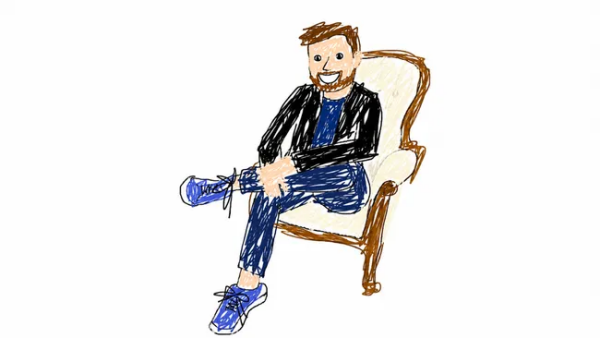
A new viral trend is emerging in which users use ChatGPT’s image-generation function to turn photos into clumsy doodles resembling the style of 1990s Microsoft Paint.
TechRadar reported on May 7 that users are sharing prompts that deliberately convert high-quality photos into sloppy, childish drawings, spreading a different kind of AI image play.
The trend is drawing attention because it runs counter to the direction generative AI image technology has pursued. AI image generation has focused on producing more realistic and refined results. Recently, some users have instead started asking for styles that intentionally lower the level of finish.
A TechRadar reporter explained, "I had been experimenting with recreating my future self or my past as photorealistic using ChatGPT Image 2.0, but this time I told the AI to move in the opposite direction." The prompt used was along the lines of: "Remake this image as a clumsy, childish doodle roughly scribbled in MS Paint using only a mouse."
The key is to deliberately emphasise awkwardness. ChatGPT actively reflected crooked outlines, irregular colouring and lines that look as if the hand hesitated. It simplifies the image while minimising detailed depiction, leaving it only barely recognisable in its original form.
When the TechRadar reporter converted a photo of himself sitting on a chair, the output retained little beyond the outline of the chair, the colour of his clothes and something like shoelaces, with most of it reconstructed as overlapping lines and rough contours. Similar traits appeared in complex landscape photos. When a photo of Belize’s jungle was converted, trees, hills and the stepped structure of ruins were reduced to simple forms centred on green lines and grey blobs. The reporter described it as "a complex landscape turned into joyful chaos."
The same approach was applied to AI-generated fantasy images. When a pulp hero-style image wearing a jetpack was converted into a doodle style, the jetpack shrank into 2 simple circles and strap-like lines, and the background city and flames were also reduced to bands of colour. The reporter explained that, compared with real photos, the childlike feel came through more strongly in imagined scenes.
What is notable is that the output does not look like a simple failure. The TechRadar reporter said, "The drawing is a mess, but it’s not random." That is because the form is preserved enough for viewers to tell what is being drawn. The reporter also said there is a difference between drawing badly by mistake and drawing badly on purpose, and explained that the lowered-finish approach reads as an intentional expression in itself.
The trend also shows that the generative AI image market is not heading only toward competition over high resolution and realism. Users are finding fun and individuality in the process of deliberately twisting or ruining familiar photos. Analysis is emerging that ChatGPT’s image function is also expanding its use beyond a simple retouching tool, becoming a play-oriented creative tool that lets users freely adjust style and finish through prompts alone.
In this flow, the point to watch is not the doodle-style conversion itself but what kind of aesthetics users demand from generative AI. It means that not only more perfect results but also deliberately clumsy and childish expression is beginning to be accepted as a new aesthetic. Ultimately, the trend is being evaluated as an example showing generative AI evolving to implement not only extremes of realism but also an intentionally "badly drawn" sensibility.
 Jinju Hong
hongjj@d-today.co.kr
Jinju Hong
hongjj@d-today.co.kr