
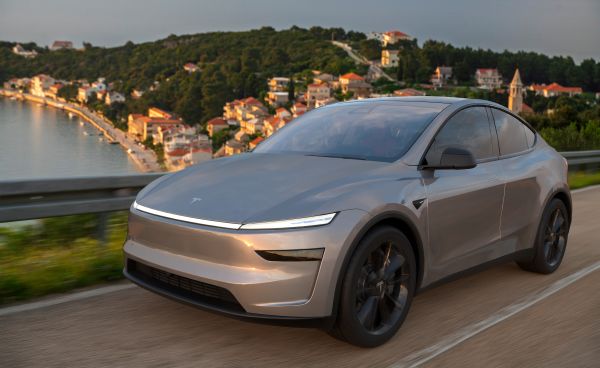
[Digital Today Seung-a Yoo] Criticism has emerged that Tesla’s in-house 4680 battery cells have reduced performance versus existing supplier batteries after being applied to European Model Y vehicles.
On May 7 (local time), EV outlet Electrek reported that Tesla applied its 4680-based "8L" pack to some trims of the European Model Y instead of batteries from existing suppliers, and some consumers see the change as a downgrade. The key issue is a decline in driving range after the battery switch in the same model. For the European Model Y Premium Long Range rear-wheel drive, the previous LG Energy Solution 5M pack was about 82 to 84 kilowatt-hours (kWh), but the 4680-based 8L pack fell to about 79 kWh, or about 74 kWh in real-world use. WLTP range dropped 52 km to 609 km from 661 km. That is about an 8 percent decline under the same aerodynamics and motor conditions.
Some assessments also said the cell’s performance itself fell short of expectations. Tesla announced at its 2020 Battery Day that 4680 cells would provide five times the energy, six times the power and a 16 percent improvement in driving range versus existing cells.
But 4680 cells produced at Giga Austin showed an energy density of 244 watt-hours per kilogram (Wh/kg), lower than 269 Wh/kg for Panasonic’s 2170 cells that had been discussed as an alternative candidate. Tesla said the latest version improved performance, but it did not disclose specific test results.
Limits also appeared in charging performance. A 2023 Model Y equipped with 4680 cells saw fast-charging output fall below 100 kilowatts (kW) from the 35 percent state-of-charge range, and it took more than 40 minutes to charge from 10 percent to 80 percent. A Model Y Long Range with 2170 batteries under the same conditions completed charging in about 27 to 30 minutes.
Recent early tests of the European 8L pack also confirmed weaker charging performance. Charging began to drop from 155 kW at 31 percent state of charge, and an evaluator said the charging curve was "very low."
Tesla said the 2026 Model Y can sustain charging of up to 250 kW at V4 Superchargers, but whether charging performance improved for the 8L pack has not been independently verified. Expansion of the 4680 also fell short of expectations in production and demand. South Korean materials company L&F disclosed that the size of its cathode-material contract for Tesla 4680 batteries fell to $7,386 (about 10.8 million won) from $2.9 billion (about 4.3 trillion won). The decline was 99.9 percent.
Sales of the Cybertruck, which Tesla had positioned as a main model for adoption, have remained at about 20,000 to 25,000 vehicles a year, while production capacity has been presented at 250,000. The 4680 battery was presented as a key technology for cutting costs. Tesla said it would halve production costs through a dry-electrode process, but CEO Elon Musk (일론 머스크) said at a 2025 shareholder meeting that the process was "much harder than expected."
Tesla initially presented production targets of 100 GWh in 2023 and 3,000 GWh in 2030, but as of 2026 the 4680 battery is being applied only in a limited way to some Model Y trims, some U.S. specifications and the Cybertruck.
European consumer backlash is also spreading. France and Norway EV communities have reported order cancellations, and complaints are growing as consumers who ordered vehicles based on a certified range of 661 km take delivery of vehicles with a range of 609 km. Some also pointed to a larger perceived gap because real-world range falls further in winter and on highways.
Tesla also has not clearly disclosed whether 4680 batteries are applied by trim, and buyers cannot confirm the battery type during the vehicle configuration process, raising concerns about information asymmetry at the purchase stage.
 Seung-a Yoo
ysah@d-today.co.kr
Seung-a Yoo
ysah@d-today.co.kr