
The Korea Internet Self-Governance Organization (KISO) is moving to set full-scale self-regulation standards for responding to false and manipulated information on platforms ahead of the revised Information and Communications Network Act taking effect in July.
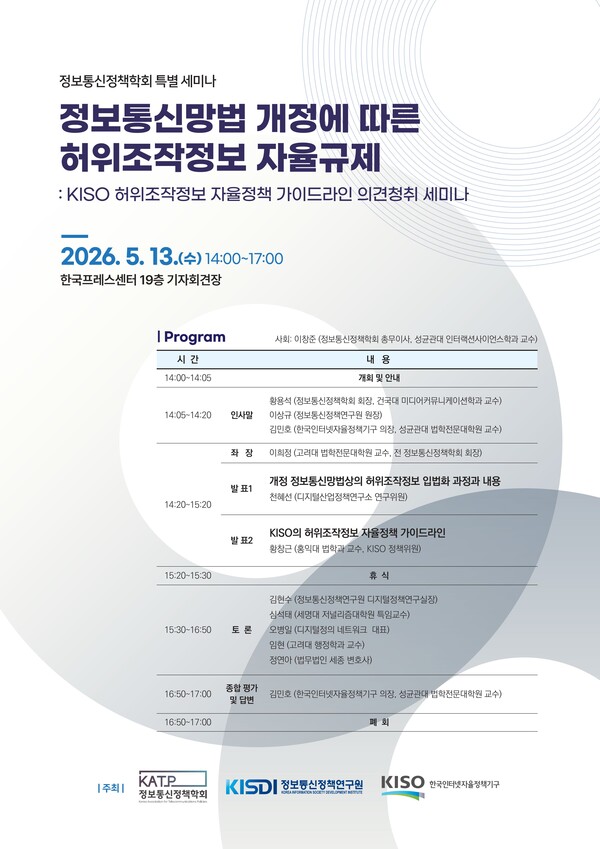
KISO said on May 8 it will hold the "Seminar to Hear Opinions on the Self-Policy Guideline for False and Manipulated Information" on May 13 at the Korea Press Center with the Korean Association for Information and Telecommunication Policy Studies and the Korea Information Society Development Institute.
At the event, KISO will for the first time disclose the self-policy guideline it prepared as a follow-up measure to the revised Information and Communications Network Act amended in January. The revised law, which takes effect on July 7, bans the distribution of information that infringes another person's personal rights, property rights or the public interest for the purpose of unjust gain while knowing it is false or manipulated information.
Under the revised law, large platform operators must mandatorily establish principles and procedures for operating self-regulation. KISO, which includes major big tech companies such as Naver and Kakao, has operated a guideline task force to prevent rights infringements while respecting freedom of expression.
The guideline is expected to include key issues for building a self-regulation system, including criteria for determining falsity and manipulation, reporting and action procedures, the principle of proportionate response, objection procedures, and ways for stakeholders to participate.
The public hearing will be moderated by Chang-joon Lee (이창준), a professor at Sungkyunkwan University. Yong-seok Hwang (황용석), a professor at Konkuk University, Sang-gyu Lee (이상규), president of the Korea Information Society Development Institute, and Min-ho Kim (김민호), KISO chairman, will deliver opening remarks. Hee-jung Lee (이희정), a professor at Korea University, will chair the session, and Hye-sun Cheon (천혜선), a research fellow at the Digital Industry Policy Research Institute, and Chang-geun Hwang (황창근), a professor at Hongik University, will present on the legislation process and the guideline content, respectively.
The discussion session will include Hyun-soo Kim (김현수), director at the Korea Information Society Development Institute, Seok-tae Shim (심석태), a special appointed professor at Semyung University, Byung-il Oh (오병일), head of the Digital Justice Network, Hyun Lim (임현), a professor at Korea University, and Yeon-a Jeong (정연아), a lawyer at law firm Shin & Kim.
A KISO official said it prepared the guideline after reviewing legislative examples and court precedents at home and abroad, as well as overseas cases. The official said platform operators will be able to draw up common standards and procedures to promote responsible service operations and user protection.
 Ho-jung Lee
lhj@d-today.co.kr
Ho-jung Lee
lhj@d-today.co.kr