
A D2C beauty brand operator recently had an unexpected experience. A product introduction video posted on social media spread among overseas users, prompting a stream of purchase inquiries from consumers in Japan and Southeast Asia. But the operator could not turn it into actual sales because an overseas shopping mall and local payment methods were not in place.
Overseas consumer interest in Korean brands is growing, led by K-beauty and K-fashion. The problem is that interest does not immediately translate into sales. Even if overseas consumers discover a product, it is difficult to convert them into purchases without the right language, payment and delivery environment.
According to the National Data Center’s "2025 trends in online direct overseas sales and purchases," online direct overseas sales totaled 3.02 trillion won last year, up 16.4% from a year earlier. That means the reverse direct purchase market is growing, centered on product categories based on the Korean Wave.
The domestic e-commerce market grew to 242 trillion won as of 2024, but its growth rate was just 5.8%. As the domestic online market enters a mature stage, overseas sales are emerging as a new growth axis for small and midsize online businesses.
Still, overseas sales remain a field with high barriers to entry for early-stage founders and small businesses. Simply building a shopping mall that can be accessed from overseas is not enough. A language consumers can understand, familiar payment methods and a delivery system they can trust must be in place.
Multi-language shopping malls, payments and delivery ... localisation is the key to overseas sales
The core of global sales lies in localisation, not in expanding sales channels. It is hard to expect purchase conversion by simply exposing a domestic shopping mall to overseas consumers as it is. Trust in the shopping mall is built only when product information, terms of use, and shipping, exchange and refund policies are provided in the consumer’s language.
Cafe24 supports the additional creation of multi-language shopping malls in English, Japanese and other languages based on a domestic shopping mall. When products are registered in the domestic shopping mall, the information is linked to the multi-language shopping mall without a separate product registration process. Founders can set up shopping environments tailored to consumers in multiple countries based on a single product database.
Localising payments also determines conversion rates. Overseas consumers prefer payment methods they are familiar with in their own countries over unfamiliar payment systems or paying in won. If they feel inconvenience at the payment stage, they are more likely to abandon even after putting products in their carts.
Japan is a case that clearly shows the importance of payment localisation. Besides credit cards, convenience store payments and the use of simple payments account for a large share, and how much the local payment environment is reflected has a direct impact on purchase conversion.
Cafe24 is supporting local payment services in Japan by working with global payment agencies. It provides integrated support for credit cards such as Visa, Mastercard and JCB, as well as convenience store payments at 7-Eleven, Lawson and FamilyMart and simple payment methods such as Line Pay, Rakuten Pay and Amazon Pay.
It is also strengthening its response to the European and North American markets. Cafe24 is working with global e-commerce company Global-e to support handling complex procedures within its platform, including overseas sales agency services, local currency payments, duty and tax calculations and overseas settlement.
Delivery is also a variable that determines the success or failure of overseas sales. For overseas consumers, delivery is not just a logistics procedure but a standard for judging the trustworthiness of a shopping mall. If delivery times are uncertain or costs are excessive, consumers may drop out just before payment.
Cafe24 supports cost reductions of up to about 70% when using express services through integration with international logistics partners, and it also applies discounted EMS rates. Just as fulfillment became a basic strength for shopping malls in domestic sales, a stable logistics network in overseas sales serves as infrastructure that affects purchase conversion and repeat purchases.
Not building, but using ... Cafe24 PRO Global reduces operating burdens
The barrier to overseas expansion shows up more in operations than in technology. That is because producing multi-language content, setting up payments by country, establishing shipping policies, responding to duties and taxes, and customer support that considers time differences each require expertise and experience. For this reason, many businesses stop at the execution stage even after confirming the possibility of overseas sales.
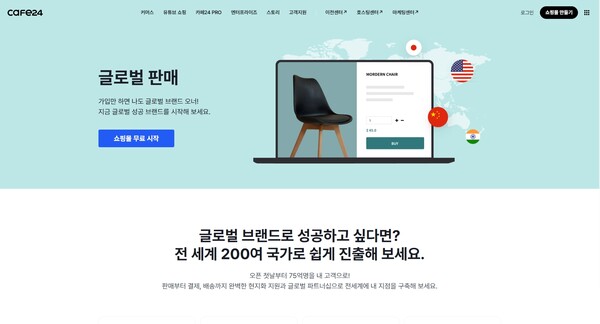
For founders burdened by direct setup and operations, the Cafe24 PRO Global service can be an alternative. Cafe24 PRO Global is a service that provides one-stop support for the processes needed for overseas sales, including building overseas shopping malls mainly for English and Japanese sites, product translation, automated merchandising, payment integration and international shipping.
Founders can set up an overseas sales environment without having a separate global operations organization. It goes beyond translating the shopping mall screen and also localises content reflecting consumer characteristics and purchasing patterns by country. The focus is on providing a user experience that feels familiar to local consumers, from product detail pages to the payment stage.
The burden of logistics operations is also reduced. Overseas orders and deliveries are linked to the logistics partner Fastbox, moving through export declaration, overseas transport, customs clearance and local delivery. Operators can focus on preparing and shipping products domestically, while complex global logistics procedures can be handled through the system afterward.
It also provides features to link with global markets and advertising channels. Operators can register products on multiple overseas marketplaces and adjust operating strategies while checking performance data. It is a structure in which overseas sales do not stop at simple channel expansion but lead to data-based operations.
Online startups are expanding to the stage of overseas sales after opening shopping malls, planning products, marketing, logistics and using technology. The era in which founders build every function and infrastructure themselves is passing. What is needed is the ability to use platforms and solutions suited to each stage to increase a business’s execution capability.
The same applies to global sales. Setting up all the language, payment, delivery and operating systems needed for overseas expansion directly requires a lot of time and money. But using platforms allows small shopping malls to meet overseas consumers with a lower burden.
In the end, the area founders should focus on is not building complex global infrastructure, but creating products and brands that work with consumers around the world. Brands that have confirmed their potential in Korea meeting overseas consumers directly using platforms. That is the next growth method for online startups in the era of reverse direct purchases.
 Hojeong Lee
lhj@d-today.co.kr
Hojeong Lee
lhj@d-today.co.kr