
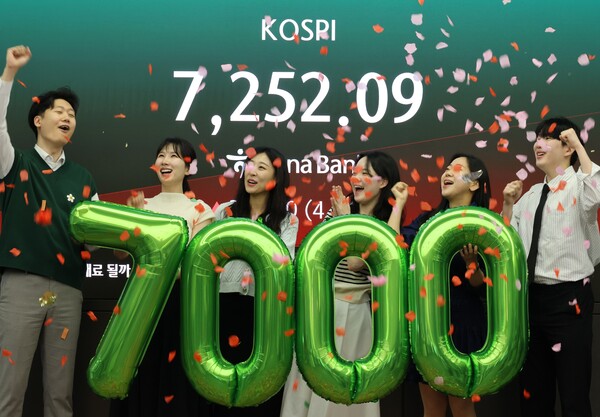
South Korea's benchmark KOSPI crossed 7,000 for the first time on Tuesday shortly after the market opened. The index, which closed at 6,936.99 on May 4, leaving 63.01 points to the 7,000 mark, scaled the new level early as gains in U.S. stocks, momentum in AI semiconductors and improved foreign inflows combined.
The Korea Exchange said the KOSPI opened at 7,093.01, reaching the historic 7,000 level. After regaining 3,000 on June 20, 2025 for the first time in 3 years and 6 months, it first topped 4,000 on Oct. 27 that year and broke through 5,000 intraday on Jan. 22, 2026.
It cleared 6,000 at the open on Feb. 25. That means it reached 7,000 in less than a year after regaining 3,000.
Semiconductors have been at the centre of the rally. Expanding investment in AI servers and rising demand for high-bandwidth memory (HBM) lifted earnings expectations for major chipmakers including Samsung Electronics and SK Hynix.
Semiconductors were also the key sector that led an expansion in market capitalisation when the index broke above 6,000, and the two companies' combined market-cap weight was close to 40 percent of the KOSPI.
Policy expectations also supported the index. Expectations for government measures to advance capital markets, expanded shareholder returns and improved dividend policies combined to fuel hopes of easing the so-called Korea discount. Value-up related indexes and exchange-traded funds (ETFs) also outpaced the KOSPI, encouraging inflows of investment funds.
The global equity backdrop was also supportive. In New York on May 5, the Dow Jones Industrial Average ended at 49,298.34, the S&P 500 at 7,259.21 and the Nasdaq at 25,326.126. As the S&P 500 and the Nasdaq rewrote record highs, appetite for risk assets carried into the domestic market.
Foreign buying helped amplify gains. Foreign investors were estimated to have net bought 2.9 trillion won of KOSPI shares the previous day. The market is seeing analysis that additional gains may still be possible if the uptrend led by AI value-chain leaders continues.
Concerns about the pace have risen. The KOSPI took about 4 months to move from regaining 3,000 to 4,000, about 3 months from 4,000 to 5,000, and only 18 trading days from 5,000 to 6,000. With the move to 7,000 also unfolding quickly, the possibility remains of short-term profit-taking and increased sector-by-sector volatility.
The industry sees whether the post-7,000 market broadens from a semiconductor-only drive to sectors showing improved earnings as important. Analysis suggests investors should pay attention to sectors including semiconductors, chemicals, energy, hardware and shipbuilding.
Breaking 7,000 is a symbolic event that South Korea's stock market has once again entered a phase of revaluation. Still, with the index at a higher level, the market is more likely to shift toward a focus on profits rather than liquidity, results rather than expectations, and actual shareholder-return outcomes rather than policy momentum.
Yeonsu Ko (고연수), an analyst at Hana Securities, said, "With solid earnings growth expected to be led by semiconductors, there is a need to pay attention to the possibility of a broader base of foreign investors."
Ko added, "The 2026 estimate for KOSPI operating profit is 867 trillion won, up 182.5 percent from a year earlier, and is expected to post the steepest growth among major global stock markets," and said, "Fund inflows centred on the KOSPI will continue."
 Sangyeob Oh
yub@d-today.co.kr
Sangyeob Oh
yub@d-today.co.kr