
A South Korean research team has developed computing hardware that can be implemented using existing silicon semiconductor processes alone. It is expected to enable faster and more accurate decision-making across industries by solving combinatorial optimisation problems.
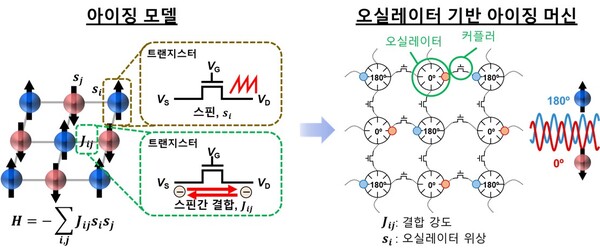
KAIST said on Tuesday that a joint research team led by professors Yangkyu Choi (최양규) and Sanghyun Kim (김상현) of the School of Electrical Engineering succeeded in implementing an oscillator-based Ising machine, a next-generation optimisation-dedicated hardware platform, using only existing silicon semiconductor processes.
Combinatorial optimisation problems refer to finding the most efficient answer among all possible cases. An Ising machine is a special-purpose computer designed to solve such combinatorial optimisation problems.
The team focused on oscillators, which are oscillating devices that repeatedly generate signals at regular cycles. As multiple oscillators exchange signals and align their rhythms, the system naturally reaches a stable state and finds an optimal solution. Existing Ising machines have had limitations, including difficulty precisely controlling slight frequency deviations between oscillators and restricted connectivity between devices.
To overcome this, the team introduced a method that implements both the oscillators and the couplers that connect them using a single silicon transistor. A coupler is a device that adjusts the strength of interaction between components. This reduced frequency deviations between oscillators and enabled stable synchronisation. The team also implemented multi-state coupling that adjusts connection strength in multiple steps using couplers.
As a result, it improved both the expressiveness of the Ising model and solution-search performance. Using the technology, the team succeeded in solving Max-Cut, a representative combinatorial optimisation problem. Max-Cut seeks to maximise connections between groups when a network is divided into 2 groups, and it can be directly used in logistics route optimisation, financial portfolio construction and semiconductor circuit placement.
A key feature of the research is that it used the complementary metal-oxide semiconductor (CMOS) process currently used in the semiconductor industry, without special materials or non-standard processes. CMOS is a standard semiconductor manufacturing technology used in most digital devices, including smartphones and computer central processing units, because it consumes less power and generates less heat. KAIST stressed that the technology can be mass-produced and commercialised on existing semiconductor production lines.
Yangkyu Choi of KAIST said, "This research is Ising machine hardware that secures both scalability and precision by implementing both oscillators and couplers as silicon devices." He added, "We expect it to be applied to various industrial fields that require large-scale combinatorial optimisation, including electronic design automation, communication network optimisation and resource allocation."
The study, conducted with support from the National Research Foundation of Korea, had Seongyun Yoon (윤성윤), a KAIST doctoral student, and Junpyo Kim (김준표) as co-first authors. It was published on March 27 in Science Advances.
 Jin-ho Lee
jhlee26@d-today.co.kr
Jin-ho Lee
jhlee26@d-today.co.kr