
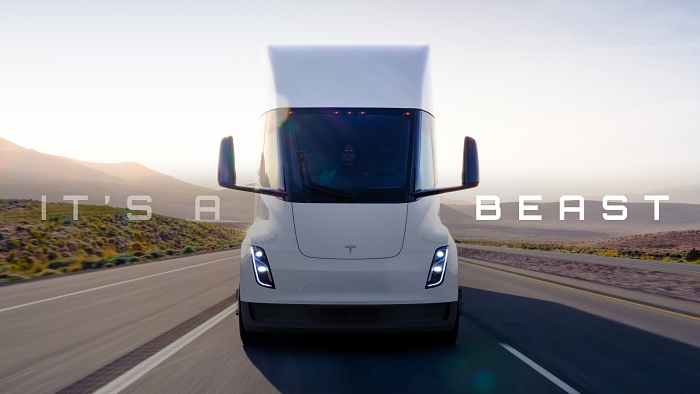
[DigitalToday reporter Hyunwoo Choo] This week’s mobility market saw a series of major headlines centred on Tesla. Full-scale mass production of the Tesla Semi began after a nine-year wait. Tesla’s cumulative autonomous-driving mileage also topped 10 billion miles, adding momentum to the push to commercialise full self-driving.
At the same time, it was a week of mixed expectations and concerns, including an uncertain robotaxi timeline, expanded investment in AI and robotics, and a hardware generational shift. In the traditional automaking industry, there was also news of retreats amid an offensive, including GM halting an electric pickup and Sony-Honda pulling back from electric vehicles.
• Tesla Semi begins mass production after 9 years, seen as a signal flare for a reshuffle in the truck market • Tesla FSD tops 10 billion miles, will 'full self-driving' become reality?
Tesla’s electric Semi truck has entered full-scale mass production, nine years after it was unveiled in 2017. With a strategy of starting in short-haul logistics and expanding to long-haul transport, an assessment is emerging that it is the first signal that could shake the U.S. truck market, which is centred on internal combustion engines. It was the week’s most-read story, with about 100,000 views.
The cumulative mileage for Full Self-Driving (FSD) also surpassed 10 billion miles. The industry view is that as cumulative real-world road data accumulates, the sheer scale of safety verification has changed. Tesla is emphasising, based on this, that the era of full self-driving could arrive sooner than expected.
• Tesla: "Only the Roadster will be manual"; declares shift to self-driving across the lineup • EV range at 95 percent after 5 years, negligible level
Tesla has formalised its policy of shifting its entire lineup to a self-driving system, except for its next-generation sports car, the Roadster. It was a declaration that it aims for a future in which holding the steering wheel becomes an exceptional experience, and it has caused a significant ripple across the industry.
Separately, positive data on electric-vehicle battery durability was released. An analysis found that range remains at about 95 percent of the initial level even after five years, drawing attention as a basis to ease consumer anxiety about long-term EV ownership.
• Tesla Optimus production to start in July-August; Model S and X lines to be converted • Tesla to raise 2026 capital spending to $25 billion, a bet on AI and robotics • Why SoCar brought in Tesla: "A pump-priming step for the subscription business"
A shift in Tesla’s strategic centre of gravity from electric vehicles to AI and robotics was detected across multiple articles this week. Mass production of the humanoid robot Optimus will start in July to August, and existing Model S and X production lines are set to be converted to robot production. Tesla also sharply increased its 2026 capital spending to $25 billion, with a significant portion focused on AI infrastructure and robotics.
In South Korea, SoCar outlined a strategy to use the introduction of Tesla vehicles into its car-sharing service as a foothold to expand its subscription business.
• GM indefinitely halts next-generation electric pickup and SUV, a return to internal combustion engines • Volvo starts mass production of EX60 electric SUV, targets 40,000 units a year • Young Chinese: "BMW and Buick are parents' cars", Western brands' foothold shaken
Fortunes diverged across global automakers over the shift to electric vehicles. GM said it would indefinitely halt development of next-generation electric pickup trucks and electric SUVs that had been planned. It is a strategy of returning to an internal combustion engine-centred portfolio, citing battery costs and demand uncertainty. Sony-Honda’s joint venture was also reported to be stepping away from the electric-vehicle business.
Volvo, by contrast, entered mass production of the EX60 electric SUV and announced a goal of producing 40,000 units a year. Strategic differences are becoming more pronounced between European brands pursuing a selective focus and U.S. and Japanese brands choosing large-scale withdrawals. In China, a survey found that as domestic electric-vehicle brands advance, Western brands such as BMW and Buick are rapidly losing ground among young consumers. BYD unveiled a 1,000-horsepower-class electric supercar, the Denza Z, aiming to fill the gap left by the Tesla Roadster.
• U.S. rental cars: EV reservations jump 25 percent as drivers fear gasoline prices • U.S. charging infrastructure mocks new-car slowdown as fast-charging ports top 70,000 • Charging is key in the EV era; Uber to build infrastructure directly
Mobility news beyond Tesla also drew market attention. A Level 4 autonomous electric truck called the Humble Hauler, which removes the driver’s seat itself, emerged and suggested a new direction for commercial autonomous vehicles. In the U.S. rental car market, EV reservations surged 25 percent from a year earlier as consumers avoided the burden of oil prices. Regardless of slowing new-car sales, the number of fast-charging ports in the United States surpassed 70,000, and Uber is moving to build charging infrastructure directly, increasing its presence in the EV ecosystem.
 Hyunwoo Choo
cookinpapa@d-today.co.kr
Hyunwoo Choo
cookinpapa@d-today.co.kr