
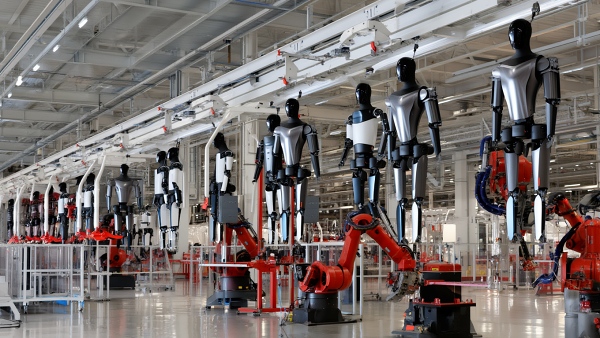
[Digital Today reporter Yoonseo Lee (이윤서)] Tesla unveiled plans to convert the Model S and Model X production line at its Fremont plant into a production line for its humanoid robot Optimus, building a first-generation line with annual capacity of 1 million units.
On May 2 (local time), electric vehicle outlet CleanTechnica reported that Tesla detailed plans to expand its robot business in its latest quarterly shareholder report.
In the report, Tesla said it would soon begin preparations in the second quarter for its first large-scale Optimus factory. It said a first-generation line designed for annual output of 1 million units would replace the Model S and Model X line in Fremont. It also said it is preparing a second-generation line at its Texas Gigafactory. That line is designed with a long-term goal of annual capacity of 10 million units.
The key issue in the plan is actual demand, rather than the speed of the production switch. Tesla said it would use space that previously produced about 40,000 Model S and Model X vehicles a year to make 1 million Optimus robots annually, but it still lacks a detailed explanation of who would buy that volume and for what purpose.
Price and performance for Optimus were also cited as variables. Optimus is expected to cost tens of thousands of dollars per unit after launch, but it has yet to show sufficiently notable capabilities. Critics said it is unlikely that general consumers would pay more than $30,000 (about 44 million won), and that its ability to perform everyday tasks such as cleaning, washing dishes, doing laundry, grocery shopping and garden maintenance has yet to be confirmed.
Sales to individual consumers are also difficult for now. Tesla has set the timing for consumer sales of Optimus for late 2027. As a result, early demand is likely to come from Tesla’s own factories or production sites at other manufacturers. Still, critics say it is unclear how much incentive companies will have to pay tens of thousands of dollars for humanoid robots that still have limitations, given that industrial sites already use robots specialized for specific tasks.
Tesla’s blueprint is very aggressive in terms of production scale. If the Texas second-generation line comes online after the Fremont first-generation line, the Optimus business could grow into a major production pillar separate from vehicle manufacturing. Still, it remains unclear where order volume will come from, whether at 1 million units a year or at a lower level.
In this situation, there are 2 points the market will watch. One is how much productivity Optimus can prove in actual factory environments. The other is whether early customers and price competitiveness can be confirmed to support the high production targets. As Tesla has disclosed its production plan first, companies that actually adopt it and use cases are expected to become the standard for judging commercial viability.
The Optimus business is presented as an important pillar in Tesla’s long-term growth narrative, but the production target is still ahead of demand validation. Whether humanoid robots can create a large consumer market like electric vehicles is likely to depend on the pace of price declines, actual work capability and maintenance costs.
In particular, for a 1 million-a-year production system to become reality, it must prove stability and economic viability in repetitive tasks beyond simple demonstrations. Whether Tesla can build use cases at its own factories first and expand them to external manufacturers is cited as a factor that will determine early success or failure for the Optimus business.
 Yoonseo Lee
yslee@d-today.co.kr
Yoonseo Lee
yslee@d-today.co.kr