
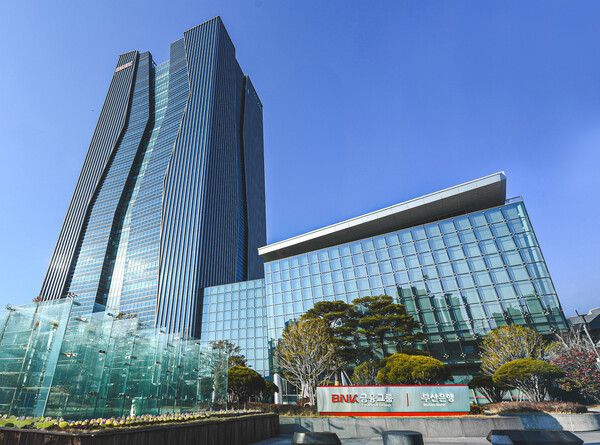
Three regional financial holding groups — BNK, JB and iM Financial Group — achieved asset growth in the first quarter, but their profit structures showed mixed results. While interest income expanded across the board, differences emerged in non-interest income, costs and asset quality management.
In the financial sector, the three groups’ combined first-quarter net profit was 532 billion won, up 9.9 percent from a year earlier. Net profit rose at all three, but the pace of growth and qualitative details differed clearly.
BNK Financial Group posted first-quarter net profit of 211.4 billion won, up 26.9 percent from a year earlier, delivering an earnings surprise. JB Financial Group rose 2.1 percent to 166.1 billion won, and iM Financial Group edged up 0.1 percent to 154.5 billion won.
BNK Financial Group offset a drop in non-interest income and higher selling, general and administrative expenses with growth in interest income and a fall in credit loss provisions. Both banking and non-banking units supported results.
Busan Bank posted 108.1 billion won, up 26.3 percent, while the non-banking segment surged 73.8 percent to 59.6 billion won. Major affiliates improved evenly, except Kyongnam Bank, which slipped slightly by 1.9 billion won. Profitability indicators also rose, with ROE at 7.83 percent and ROA at 0.53 percent.
JB Financial Group was effectively similar to a year earlier as non-interest income fell despite higher interest income. Non-interest income plunged 40.8 percent, missing market expectations, as gains related to securities declined on rising market interest rates.
Core affiliate JB Woori Capital grew 24.3 percent and played a defensive role, but that was not enough to offset weakness in the bank and other non-bank units. Jeonbuk Bank posted 39.9 billion won, down 22.5 percent from a year earlier, and Kwangju Bank reported 61.1 billion won, down 8.7 percent.
iM Financial Group also posted net profit similar to a year earlier, showing somewhat weak performance. Key affiliate iM Bank reported 120.6 billion won, down 3.6 percent, and iM Securities posted 21.7 billion won, down 20.6 percent.
Still, non-interest income expanded 8.3 percent as fee income and securities-related gains rose together. iM Capital grew 31.3 percent and iM Life climbed 63.4 percent, lifting the share of non-bank profit to 34.0 percent.
◆ Differences emerge in non-interest income and capital
As a result, capital units became a core pillar of performance for all three regional financial groups in the first-quarter results. Profits rose 38.9 percent at BNK Capital, 24.3 percent at JB Woori Capital and 31.3 percent at iM Capital. As the growth trend in interest income slows, the shift toward a capital-centred profit structure is strengthening.
Non-interest income showed mixed results. BNK Financial Group delivered results in profit diversification through broad improvement in non-bank businesses such as asset management, while iM Financial Group also saw a recovery in securities and fee income. JB Financial Group, however, lagged as non-interest income fell sharply due to weaker securities gains and losses.
Asset quality indicators also diverged. BNK Financial Group’s NPL ratio improved 12 basis points from the previous quarter to 1.57 percent, but its delinquency ratio rose 28 basis points to 1.42 percent. A BNK Financial Group official explained that an increase in bad loans reflecting an economic slowdown had been factored in and that proactive asset quality management would be needed going forward.
JB Financial Group’s NPL ratio rose to 1.41 percent and its delinquency ratio climbed to 1.63 percent, with both indicators increasing. The delinquency ratio, in particular, rose 25 basis points. The company said the impact was largely due to one-off factors.
Seung-kook Lee (이승국), JB Financial Group’s chief risk officer, stressed that the asset quality figures were influenced by an increase in the denominator. He said it was not because provisions declined, but due to the impact of rising NPLs. He said household loans are classified as NPLs after being delinquent for more than 90 days, while most corporate loans are classified as NPLs immediately under the structure.
He added that corporate loans have a high share of collateral and are managed through individual assessments. He also said the fact that the coverage ratio is below 100 percent is a burden factor and that additional improvement measures are under review.
iM Financial Group’s NPL ratio improved 25 basis points from the previous quarter to 1.38 percent. Its delinquency ratio also fell from the previous quarter to 1.43 percent. The group plans to manage asset quality by maintaining a conservative provisioning stance and by cleaning up real estate project finance assets and pursuing write-offs and sales.
Shareholder return policies were strengthened at all three groups. BNK Financial Group set a dividend of 150 won per share and expanded its buyback and cancellation plan to 60 billion won. JB Financial Group raised its quarterly dividend to 311 won and presented a plan to return 50 percent of net profit. iM Financial Group is maintaining its plan to buy back and cancel 150 billion won worth of shares through 2027.
CET1 ratios were 12.61 percent for JB Financial Group, 12.30 percent for BNK Financial Group and 11.99 percent for iM Financial Group. iM Financial Group’s relatively low capital ratio could act as a variable in expanding shareholder returns going forward.
In this regard, Hong-seon Yeom (염홍선), an executive vice president at iM Financial Group, said the CET1 ratio fell about 19 basis points due to the impact of foreign exchange rates. He said the group plans to secure additional headroom through RWA management and portfolio rebalancing to reduce foreign exchange sensitivity.
 Ji-young Lee
ljy@d-today.co.kr
Ji-young Lee
ljy@d-today.co.kr