
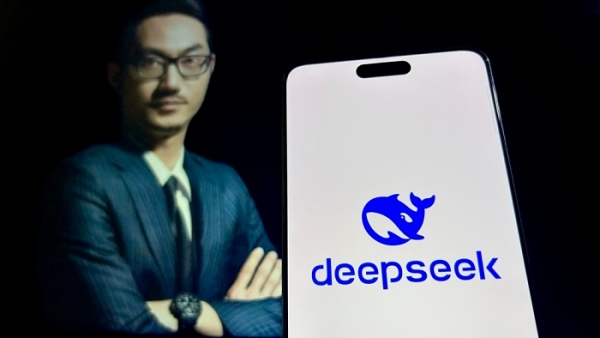
As DeepSeek founder and CEO Liang Wenfeng’s extended absence continues, senior researcher Chen Deri is emerging as the company’s new public face.
Hong Kong’s South China Morning Post (SCMP) reported on April 28 that Liang has rarely appeared in public since a televised meeting with Chinese President Xi Jinping in February last year. Recent changes in the ownership structure show his control of the company has strengthened.
Corporate information database Qichacha shows Liang’s stake in DeepSeek has increased to 34 percent from 1 percent. His paid-in capital also rose to 5.1 million yuan from 100,000 yuan. DeepSeek’s total registered capital increased to 15 million yuan from 10 million yuan.
Attention is focused on the fact that the changes coincided with DeepSeek’s first move to raise outside funding. Under China’s Company Law, major decisions require approval from shareholders holding at least two-thirds of voting rights.
At the same time, Chen is increasingly taking charge of the company’s external messaging. DeepSeek recently unveiled a new AI model, V4. It did not have the same impact as the R1 model released last year, but it drew market attention again by highlighting cooperation with Huawei and a low-price strategy.
The most prominent figure in the process was not Liang but Chen. Soon after the V4 launch, Chen wrote on his personal X account, formerly Twitter, that he was "humbly sharing the results we poured our love into after 484 days" and that he would "as always, uphold long-termism and open source for everyone." The message drew attention as a rare public statement at a time when DeepSeek researchers’ online activity has fallen sharply.
Chen is a key researcher whose name has appeared on major model development efforts including V3, R1 and V4 since joining DeepSeek in 2023. His archived GitHub profile shows he completed undergraduate and master’s programs at Peking University and was active in a language computing and machine learning group while in college. Google Scholar shows his papers have been cited more than 22,000 times.
He has already effectively served as the company’s representative at several public events. His first major public appearance was Nvidia’s GTC event in March last year. He delivered a roughly 20-minute presentation representing DeepSeek and its parent company, High-Flyer Quant. He said it would be difficult for AI models to satisfy all human values at once and proposed a "decoupling" approach that allows different cultural value systems.
In November last year, he attended a state-backed industry event in place of Liang and appeared on stage with other major corporate executives. He voiced a relatively pessimistic view of AI’s social impact and warned that most jobs could ultimately be automated. He also drew attention by arguing that AI companies should act as "Whistle Blowers" by telling the public which occupations will disappear first.
The market is also watching how well DeepSeek is retaining its core researchers. In China’s AI industry, competition to recruit talent among large tech companies such as ByteDance, Alibaba and Tencent has intensified, and concerns about research staff departures have been raised consistently.
Still, a technical document released with the V4 launch showed DeepSeek has succeeded in maintaining a certain level of defense. DeepSeek’s research and engineering staff increased to 270 from 212 in early December last year. The growth rate exceeded 27 percent. Most of 18 key contributors to the R1 model’s development were confirmed to still be at the company. Only 2 people have left; Guo Daya moved to ByteDance, and Zhang Haowei’s subsequent destination has not been disclosed.
The market’s interest in DeepSeek’s next steps is growing as the founder’s extended absence, the rise of a new public face, efforts to raise outside investment and the retention of key researchers intersect.
 Jinju Hong
hongjj@d-today.co.kr
Jinju Hong
hongjj@d-today.co.kr