
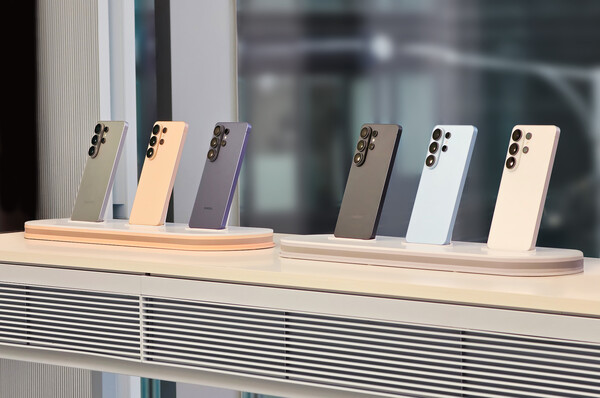
A memory boom is weighing on Samsung Electronics' smartphone business. Despite raising the launch price of the Galaxy S26, a spike in memory prices is making it difficult to protect profitability. Samsung Electronics said on its first-quarter conference call on Wednesday that memory prices are expected to rise further in the second quarter of 2026, increasing cost burdens. It said a year-on-year drop in profitability is unavoidable.
The cost structure of its smartphone business has already come directly under the influence of memory supply and demand. As AI server memory demand expands, tight supply for mobile memory and rising prices are continuing, worsening profitability in the first quarter from a year earlier. As the group's memory business posts record results, the MX (Mobile eXperience) division is facing the opposite pressure. That contrasts with the DS (Device Solutions) division, which recorded quarterly operating profit of 5.37 trillion won, the highest ever for a quarter, in the first quarter.
Its response strategy is proceeding on two tracks: strengthening the premium line-up and improving cost efficiency. Samsung Electronics said it will continue to push to expand sales of the S26 and new A series based on stable supply, while also pursuing cost efficiencies across development, procurement and sales. It said it will try to defend as much as possible against a decline in profit caused by rising memory prices. Despite the S26 price increase, the company plans to raise perceived value by improving performance and strengthening communication on core customer experience.
Sales growth drivers are multi-layered. The company aims to drive revenue growth through foldables, M-1 and FE, which are currently selling well, and to grow across all segments by leveraging the A57 and A37 launched in April. In first-quarter results, an increase in the share of Galaxy S26 Ultra sales showed a trend of growth in both revenue and operating profit. The company said it is trying to overcome high cost increases through premium sales and upselling and expand sales with mobile AI leadership and a stable supply chain, but that a year-on-year decline in profitability is expected to be unavoidable.
◆ Defending share also a task as the market contracts in 2026
The market environment itself is also unfavourable. Samsung Electronics forecast that the smartphone market in 2026 will grow slightly in value terms from a year earlier, but will drop sharply in volume terms. Rising average selling prices will increase the market's overall value while shipments fall. In that environment, Samsung Electronics plans to outperform the market in both value and volume. As the global smartphone market enters a period of slowing shipments due to longer replacement cycles and the impact of inflation, a clearer trend is emerging of defending revenue through price increases.
In the end, increasing the share of flagship models has become important. In addition to the S26 price increase, the company needs to drive revenue growth with its premium line-up including foldables, M-1 and FE, while defending share in the mid- to low-priced market with new A series models. To do this, the company aims to use its portfolio across all price bands to pursue both market share defence and revenue growth even in a slowing market.
This pressure on profitability is not limited to Samsung Electronics. With supply prioritised for AI servers, rising mobile memory prices are a factor affecting global smartphone makers in the same way. As rivals such as Apple, Xiaomi and Oppo face the same cost pressure, the possibility is also being raised that price increases could spread across the broader market. Whether Samsung Electronics' decision to raise the S26 launch price becomes the starting point of a global price hike cycle is a point to watch. The impact is expected to be larger for flagships, where memory accounts for a higher share of smartphone costs.
There are also factors that could partially offset the cost burden. Currency effects helped first-quarter results to some extent. The company explained that rises in exchange rates for major currencies including the dollar generated a positive effect of about 1.8 trillion won from the previous quarter, centred on the components business. But that effect was concentrated in the components business, and it is seen as having limits in offsetting the deterioration in profitability at the MX division alone.
A key question is how long the memory price upcycle lasts. As Samsung Electronics forecast that in 2027 the profitability gap between conventional DRAM and HBM (high bandwidth memory) will narrow sharply, the burden from mobile memory prices could gradually ease after 2027. But for about the next 18 months, the MX division faces a period in which it must hold out through price increases and cost efficiencies. Whether it can defend market share during this time is expected to be a factor determining resilience in the subsequent recovery period.
 Dae-geon Seok
d2dg@d-today.co.kr
Dae-geon Seok
d2dg@d-today.co.kr