
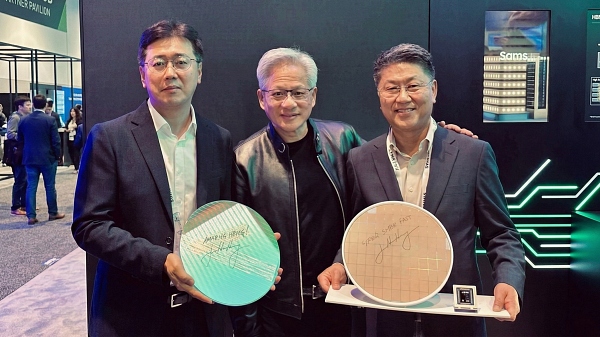
A change is being detected in what drives profitability at Samsung Electronics' memory business. NAND flash and the foundry business are emerging as the next pillars after HBM, or high-bandwidth memory, and DRAM powered record quarterly results. NAND moved up its next-generation SSD lineup in line with Nvidia's new storage architecture proposal, and the foundry business has entered a stage where orders from large AI high-performance computing customers are becoming visible on its 2-nanometre process.
Nvidia created the trigger that changed the direction of the NAND market. At its GTC event, Nvidia proposed an architecture such as CMX that expands storage of data generated during AI inference from only HBM to NAND-based storage. It did so because a structure centered only on expensive HBM and DRAM has increased burdens in cost and capacity. It is a sign that NAND, which had faced big concerns about losses, is returning as an AI beneficiary area.
Demand for high-performance storage such as TLC-based PCIe Gen6 SSDs is expected to rise accordingly. Samsung Electronics said on its first-quarter conference call on Wednesday that it has completed preparations for mass production of ultra-high-performance NAND storage solutions based on Gen6 as well as Gen5. It said it secured positive feedback from key customers on differentiated performance in initial Gen6 sample evaluations. The company plans to pre-empt initial demand in the Gen6 market in the second half, centered on AI servers and data centres.
It has also expanded its lineup in the QLC segment. Samsung Electronics completed development of 2TB QLC in March. Based on that, it plans to expand ultra-high-capacity lineups such as 256TB server SSDs to improve market responsiveness. It is also accelerating a transition to V9. The company said it expects growing demand to reduce data-movement delays caused by performance gaps among HBM, DRAM and storage as storage use expands in AI systems.
A recovery in the NAND business is directly tied to the stability of profits across the overall memory business. While DRAM and HBM have led the memory boom, NAND has weighed on profitability due to weak prices. If storage demand in AI infrastructure takes off in earnest, NAND could shift into a twin profit source alongside DRAM.
Foundry, 2-nanometre AI customer orders enter visible stage
The mood in the foundry business has also changed. Samsung Electronics said it is actively holding talks on 2-nanometre collaboration with multiple large AI HPC customers, and expects to secure visible results with some customers in the near term. It delivered a much clearer tone on progress in orders than in the previous quarter. It cited clearer customer demand to secure both memory and foundry supply as memory supply tightens.
Progress at its Taylor fab in the United States has become more specific. Fab 1 held an equipment move-in ceremony on April 23. The plan is to ramp up capacity for 2-nanometre production step by step after operations in 2026 and the start of mass production in 2027. For Fab 2, it is conducting initial reviews for construction while holding order talks with global customers. There is an assessment that securing advanced-process capacity in the United States is also meaningful in responding to tariff risks.
Efforts to broaden applications are also accelerating. A 4-nanometre-process HBM4 base die has been recognised for strong performance, driving 4-nanometre demand. Discussions are under way with automotive and robotics customers in the Americas and Greater China regions on adopting 2-nanometre and 4-nanometre processes. In the data centre segment, demand for silicon photonics is also rising rapidly. With a major optical communications module company, it will start task mass production from the second half of 2026.
At the same time, restructuring is under way in legacy processes. Samsung Electronics plans to focus capabilities on high value-added specialty demand while decisively winding down processes with low competitiveness. It will shift capacity for CIS and DDI product lines to 27 nanometres. It will also proceed sequentially with line closures for PMIC, DDI and CIS products being mass-produced on 8-inch lines.
A simultaneous recovery in NAND and the foundry business is directly linked to the task of lowering reliance on memory alone. Samsung Electronics' first-quarter operating profit was led by rises in DRAM and HBM prices. At a time when securing additional profit sources is urgent in case price cycles for the two products turn down, it is meaningful that NAND and the foundry business showed visible progress at the same time.
Even so, time is needed before they make a full contribution to results. The foundry's 2-nanometre orders were described only as being in the "near term", and full NAND revenue from Gen6 SSDs is scheduled for the second half. The start of mass production at the Taylor fab in 2027 is expected to be a watershed for a rebound in the non-memory business.
 Dae-geon Seok
d2dg@d-today.co.kr
Dae-geon Seok
d2dg@d-today.co.kr