
[Digital Today reporter Seulgi Son] CJ ENM, the country’s largest IP holder, unveiled its feature film 'Apartment' that combines artificial intelligence (AI) with live action. It improved production efficiency, including completing filming in four days. Limits include a lack of consistency in backgrounds and differences in resolution between live-action footage and AI-generated video. CJ ENM plans to advance its AI production pipeline and expand AI use to dramas, films and advertising.
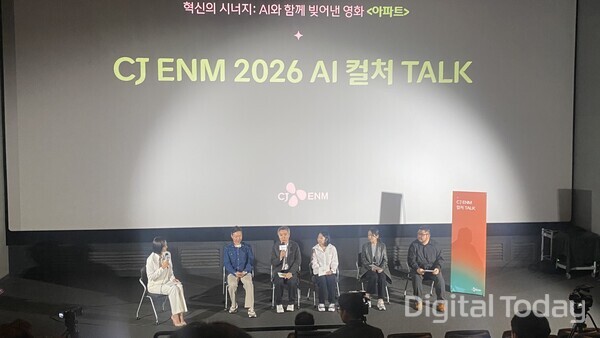
CJ ENM on April 30 held the 'CJ ENM 2026 AI Culture Talk' at CGV Yongsan I'Park Mall in Seoul and unveiled the AI feature film 'Apartment'. Actors’ performances were filmed on an indoor greenscreen, while all backgrounds and visual effects were created with AI in a hybrid approach.
The biggest change from adopting AI was production costs. The 1-hour feature film cost a total of 500 million won to make. Jang Chang-ik (정창익), head of CJ ENM’s AI Studio team, said it would have cost at least five times more using a conventional approach.
The efficiency was more pronounced because of the genre, described as a 'Korean-style occult thriller'. Creatures appear, requiring large-scale visual effects, it said. Baek Hyun-jung (백현정), head of content innovation at CJ ENM, said the project could achieve cost efficiency of more than 5 to 7 times on this work’s 기준. She said she expects production of large-scale fantasy or science-fiction genre titles could also expand through AI. Jang added that with AI there is almost no difference in production costs between a cafe scene and a monster fight scene. He said AI can break the limits of genre works that were hard to realise because of production costs.
Technically, it applied three Google AI solutions. It generated backgrounds using the image-generation model Imagen, then corrected and optimised them with Nano Banana, before turning them into video with the video-generation model Veo. Jang said it struck a good balance between realistic depiction and cinematic sensibility, and made it easy to implement desired angles. He added that background images were handled with Imagen and Nano Banana, while most video work was processed with Google solutions.
Ahn Sung-min (안성민), director of customer engineering at Google Cloud, said the most important work was not stopping at providing AI models but jointly finding use cases in the actual production process. He said they plan to build more cases with CJ ENM.
AI’s technical and directing limits are clear. Han Sung-geun (한성근), CEO of The Han Film, said consistency in backgrounds is far harder than for characters, and the key is securing detailed consistency as footage gets longer. Differences in resolution are also a problem. Jang said live-action filming is in 4K but AI-generated images are 2K or lower, creating a resolution gap. He said colour grading has no choice but to match the lower side.
Creating Korean settings was also a challenge. Because the AI model is optimised for Western images, generating Korean apartments led to a mix of Chinese and Japanese styles. Jang said they reinforced it by adding their own technology and development pipeline to Google solutions.
The pace of technological development is also a variable for producers. As AI models evolve quickly, scene replacement and background revision are frequent, and it is difficult to determine the point of completion. Jang said AI-produced content should be evaluated with the production period in mind. He said Nano Banana was released when they were producing it last summer, and a scene that had not been working for several days was resolved in one day. He added that, unlike ordinary films, AI films can be revised even after editing, which is both an advantage and a disadvantage.
CJ ENM plans to apply its AI pipeline across drama and film production and expand it to its advertising business. Baek said it is important to be the first to use and try AI to lead a content market changed by AI. She said the AI pipeline will also be applied to dramas and films that will be broadcast and screened in the future.
CJ ENM in February launched the 'AI Content Alliance' with 13 AI production companies and five educational institutions. The Han Film and Saltmakers, both part of the alliance, participated in producing 'Apartment'.
Baek said that just as blockbuster genres increased explosively after the emergence of CG, AI will also change the scale and genres of content. She said ultimately the boundary between ordinary films and AI films will disappear. She said AI cannot replace sincere acting, and stressed that a hybrid structure that preserves actors’ performances while implementing backgrounds and effects with AI is a way to keep the essence of content alive.
 Seulgi Son
sageson@d-today.co.kr
Seulgi Son
sageson@d-today.co.kr