
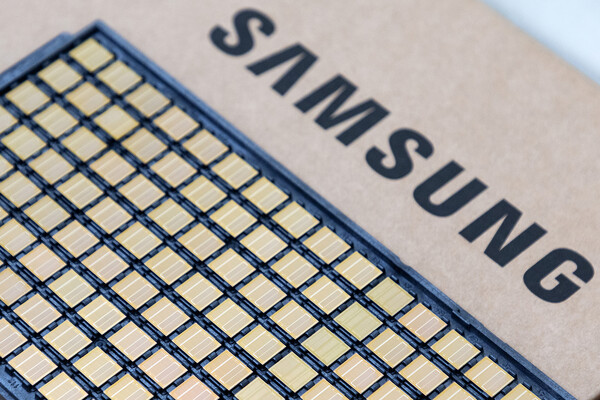
[Digital Today reporter Daegeon Seok (석대건)] Samsung Electronics' HBM (high-bandwidth memory) is sold out. With all 2026 capacity fully booked, it has started taking orders in advance for 2027 demand. Samsung Electronics said on April 30 in its first-quarter conference call that the supply gap versus 2027 demand would be more severe than in 2026.
The supply fulfilment rate versus demand is at a record low. Samsung Electronics said on the day that under a tight inventory situation, available supply is falling far short of customers' demand. It said that unlike in past years, customers worried about shortages are placing 2027 demand orders in advance. It said expanding investment in AI (artificial intelligence) infrastructure is fundamentally changing the demand curve in the memory market.
HBM sales are expanding rapidly. Full-year HBM sales in 2026 are expected to rise more than threefold from a year earlier. HBM4 in particular is a key pillar of sales growth. Samsung Electronics began mass production shipments of HBM4 in February, the first in the industry. HBM4 sales are expected to exceed half of total HBM sales from the third quarter this year, and to account for a majority on a full-year basis in 2026 as well. That means its sales share would exceed half about 6 months from the start of shipments through a full ramp-up.
Differentiated performance in HBM4 has driven the concentration of demand. Samsung Electronics said it used a 1-nanometre-based leading-edge process to raise HBM4 performance specifications. As customers adopt it, a structure has formed in which its performance advantage translates into a price premium. The company said all the capacity it prepared is sold out.
Preparations for next-generation products are also accelerating. Samsung Electronics plans to ship the first samples of HBM4E in the second quarter, supporting 16Gbps per pin speed and 4.0TB/s bandwidth. It said it is continuing business preparations for next-generation products based on 1-nanometre-based technological competitiveness built through HBM4 mass production. The market views HBM4E performance specifications as a factor that will shape the next round of competition with SK Hynix and Micron.
◆Supply constraints becoming structural through 2027 beyond 2026
Above all, a key point of the call is that the HBM supply shortage is not a short-term phenomenon. Samsung Electronics said that given the lead time required for new fab expansions, there will be constraints on industry-wide supply increases for the time being. It said memory demand is structurally rising as token throughput surges with the spread of agentic AI, while supply takes time. The company said the AI ecosystem is instead growing even faster as new technologies are introduced to improve data computation processing efficiency.
A strong market is also affecting the structure of price negotiations. HBM operates annual advance price negotiations in consideration of the lead time required to prepare backend capacity. That differs from conventional DRAM, which is negotiated on a quarterly basis. Conventional DRAM prices have risen rapidly recently, creating a reversal in profitability with HBM, but Samsung Electronics said it expects the gap to narrow sharply in 2027 given the HBM supply negotiation environment in which the supply-demand gap is continuously widening.
Second-quarter DRAM bit growth is expected to increase by the mid-single digits from the previous quarter. With availability limited, the strategy is to continue product-mix operations centred on servers. For NAND, bit growth is expected to rise by the low-single digits, due to availability constraints stemming from lower inventory levels in the previous quarter. It is a phase in which supply constraints are simultaneously operating in both DRAM and NAND.
Synergies with the foundry business are also strengthening. HBM4 base dies based on a 4-nanometre process are driving demand for 4-nanometre as their strong performance is recognised. A trend has also been confirmed in which customer demand to secure both memory and foundry is becoming clearer. Samsung Electronics said it is actively reviewing measures to expand 4-nanometre supply to respond to these market changes. That means integrated solutions combining HBM and foundry are emerging as a new axis of competition.
That makes the start timing of new capacity after 2027 more important. To meet 2027 demand that Samsung Electronics has taken in advance, it must be supported by expanding backend lines. In the memory industry, even if DRAM capacity is increased, securing backend packaging lines for HBM requires additional time. The company did not disclose specific figures on the scale and timing of capacity expansion.
The fact that demand visibility is secured through 2027 is expected to reduce earnings volatility in the memory business. Unlike in the past when the DRAM market was swayed by price fluctuations in 6-month cycles, it is positive that HBM stabilises its profit structure through annual advance contracts.
 Daegeon Seok
d2dg@d-today.co.kr
Daegeon Seok
d2dg@d-today.co.kr