
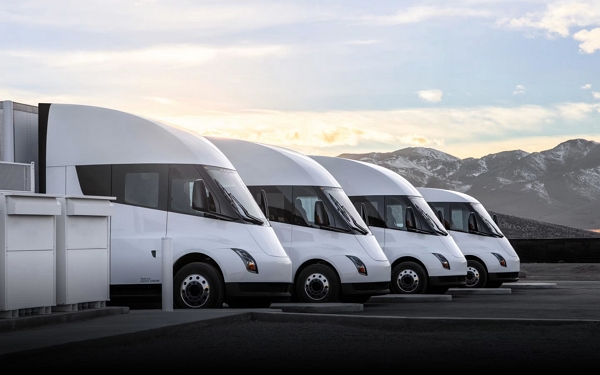
Tesla delivered the first Semi truck from a new high-volume production line at Gigafactory Nevada, entering a full commercialisation stage for its long-delayed electric truck programme.
On April 29, electric vehicle outlet Electrek reported that Tesla confirmed on its X (formerly Twitter) account that mass production had begun at a dedicated 1.7 million-square-foot plant. That made clear the delayed project has shifted to an actual production system.
The milestone means the Semi truck, first unveiled in 2017 and repeatedly delayed, has moved beyond pilot production to a mass-production system capable of 50,000 units a year. Tesla has focused on improving the design based on data from a largely manual pilot line and on building a dedicated production facility. That preparation underpinned the shift.
A key point is that the newly built Nevada line maximises efficiency through vertical integration. By manufacturing the 4680 battery cells in the same complex, Tesla resolved battery supply bottlenecks that had arisen when passenger car production took priority. The production model comes in two trims: a standard-range 325-mile (about 523 km) version and a long-range 500-mile (about 804 km) version. The long-range model is priced at about $290,000 (about 430 million won), securing competitiveness in the market.
Tesla also strengthened competitiveness on performance. Both models use an 800 kW tri-motor powertrain producing 1,072 horsepower, and a 1.2 MW Megacharger can restore about 60 percent of range in about 30 minutes. That aligns with mandatory driver rest periods, raising operational efficiency. Tesla has already opened the first Megacharger station in Ontario, California, and plans to build 66 charging hubs across 15 states.
Market response is also emerging quickly on the back of that technical and infrastructure base. In California’s clean truck and bus voucher programme applications, the Tesla Semi accounted for 965 applications, more than 90 percent of the total, outpacing rivals. That shows it has already secured a meaningful edge in initial demand.
While existing manufacturers such as Daimler and Volvo are limited to small deliveries, Tesla appears to be moving to seize the market by emphasising competitiveness on price and driving range. It is also expanding an associated ecosystem, including a 'Tesla Semi as a service' model combining vehicle rental and charging infrastructure, as broader changes in the business structure proceed.
The key going forward is balancing production ramp-up and infrastructure buildout. Tesla plans to gradually increase output with a target of producing 50,000 units a year, and the industry forecasts 2026 deliveries of between 5,000 and 15,000 units.
First Semi off high volume line pic.twitter.com/fI1AdQrJFH
 Hong Kyung-min
hongm@d-today.co.kr
Hong Kyung-min
hongm@d-today.co.kr