
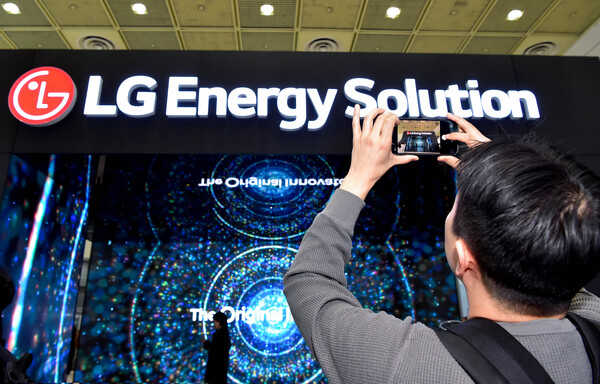
LG Energy Solution posted an operating loss in the first quarter due to an initial cost burden from expanding its North American ESS production base.
LG Energy Solution said on Wednesday it posted first-quarter revenue of 6.56 trillion won and an operating loss of 207.8 billion won. That compares with an operating profit of 374.7 billion won a year earlier. Revenue fell 2.5 percent from a year earlier but rose 1.2 percent from the previous quarter's 6.47 trillion won.
The company attributed the loss to the burden of initial stabilisation, or ramp-up, costs related to expanding its North American ESS production base. It also cited a decrease in volumes of EV pouch products for a strategic customer. North American production subsidies reflected in the first-quarter results, including tax credits under the Inflation Reduction Act, totaled 189.8 billion won.
CFO and Vice President Lee Chang-sil (이창실) said revenue rose from the previous quarter as the company responded actively to solid ESS and cylindrical demand, despite weak EV demand centred on North America. The company said ESS revenue as a share of total sales expanded to the mid-20 percent range, extending its growth trend.
It reported progress in orders. It secured more than 100 GWh in new orders in the first quarter alone for its 46-series cylindrical batteries, lifting cumulative backlog to more than 440 GWh. It said customers recognised product differentiation such as high energy density, cost competitiveness and thermal stability, as well as its production capabilities.
LG Energy Solution began mass production of its 4695 product at its Ochang Energy Plant at the end of last year. It said it plans to start mass production of various sizes, from 4680 to 46120, at its Arizona plant in the United States by year-end.
It also maintained order momentum in its ESS business. In February, it signed an additional supply contract with an existing strategic customer for a North American power grid project, with supplies scheduled from 2028. The product to be applied is a next-generation model with total cost improved by 15 percent compared with the LFP batteries for ESS currently in mass production.
It also accelerated efforts to secure production bases. In March, it decided to convert part of an existing EV line at Ultium Cells' Tennessee plant to ESS, securing a total of 5 ESS production bases in North America alone. It aims to have ESS production capacity of more than 50 GWh by year-end.
The company also presented business opportunities arising from changes in the external environment. It assessed that supply chain uncertainty and the possibility of high oil prices are increasing due to the U.S.-Iran war, boosting demand for energy self-sufficiency in each region, and that ESS combined with renewable energy will draw attention as an alternative to existing power sources. It expected consumer demand to improve in the EV market as high oil prices and unstable energy supply renew the need for the shift to electric vehicles.
On the policy front, it judged that customer preference for companies with local production bases will strengthen as supply chain localisation policy directions become more concrete, including the U.S. OBBBA and Europe's IAA.
LG Energy Solution set strengthening cash flow, responding to demand, stabilising supply chains and boosting product competitiveness as key tasks. Key measures include securing funds through the sale of non-core assets, expanding new ESS orders, upgrading raw material monitoring, and launching within the year new cylindrical products for EVs that enhance fast charging.
CEO Kim Dong-myung (김동명) said the most important thing in a period of change in which the battery industry is being newly defined is to judge the right direction and opportunities. He said the company would accelerate growth and move to pre-empt future markets based on a detailed strategy and strong execution.
 Suk Dae-geon
d2dg@d-today.co.kr
Suk Dae-geon
d2dg@d-today.co.kr