
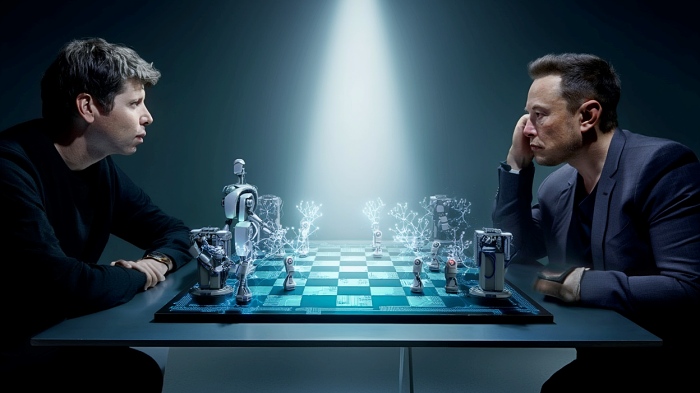
Court documents disclosed indications that Elon Musk (일론 머스크) and Sam Altman (샘 알트먼) reviewed 'Freemind' as a company name shortly before founding OpenAI. They also showed the two shared plans for an AI organisation to respond to Google DeepMind, going beyond a simple branding discussion.
Business Insider reported on April 29 that evidence submitted by Musk's side during the trial included emails exchanged between Musk and Altman in November 2015.
In the disclosed emails, Musk proposed 'Freemind' as the leading candidate for the company name. He said the name carried the meaning of an intentional philosophical counterweight to Google's AI research group DeepMind. He wrote that he wanted to reflect an aim of making digital intelligence freely available to everyone rather than allowing a specific company to monopolise it. Musk likened DeepMind's approach to a way to "rule them all with one ring" and wrote that Freemind was a name on the opposite side.
Altman did not immediately agree from the outset. He said Freemind was "a little too similar to DeepMind" but replied that he viewed the word 'free' positively. He also suggested 'Axon' as another candidate he had in mind.
Musk replied that Axon was not a bad option, but said he was concerned it could evoke Google Brain or give the impression of limiting digital intelligence to the level of mimicking the human brain. He added that "most names are bad at first" and stressed that "what matters in the end is how well it shows the company's mission and direction". He said he preferred a name that could give a positive image in recruiting.
Altman later said in another email that he was quickly leaning toward Freemind. He said the name "clearly conveys the right spirit" and mentioned he was also reviewing names related to computer scientist Alan Turing.
Musk said he viewed a Turing-related name positively, but added he wanted to avoid a direction that directly evokes the Turing test. He explained he was concerned it could make the group look like an AI organisation trying to replace humans.
The email disclosure came during the trial of a lawsuit Musk filed against OpenAI and Altman, among others. The case is a federal civil lawsuit over OpenAI's shift from a non-profit research institute to a profit-focused structure, and arguments began in Oakland, California on April 28. Musk appeared in person as the first witness and continued testifying through April 29.
The trial is currently focusing on OpenAI's organisational restructuring process and its initial founding purpose, and documents from the time of its founding and internal emails are expected to continue to be used as key evidence.
Musk also explained again in court the background to OpenAI's co-founding. He testified, "I thought it was very important to create a counterweight to Google," and said it appeared at the time that Google was not paying enough attention to AI safety issues.
Accordingly, the emails are interpreted as showing that OpenAI's early naming discussion went beyond a simple brand decision and was linked to an awareness of the need to build an AI organisation with a philosophy and operating principles different from Google's.
OpenAI launched in December 2015 as a non-profit AI research institute founded by Musk, Altman and several other co-founders.
 Jinju Hong
hongjj@d-today.co.kr
Jinju Hong
hongjj@d-today.co.kr