
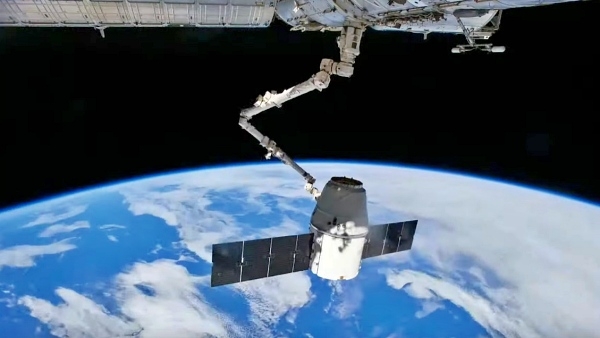
The upper stage of a SpaceX Falcon 9 rocket launched in January last year is expected to hit the moon’s near side in August.
IT outlet Ars Technica reported on April 29 that astronomers see a high chance the rocket will hit near the moon’s Einstein crater on Aug. 5 at 2.43 km per second.
The object was identified as the Falcon 9 second stage that carried Firefly’s lunar lander Blue Ghost and ispace’s Hakuto-R on Jan. 15, 2025. The two landers, the fairing and the upper stage were tracked separately immediately after separation. Blue Ghost successfully landed on the moon, but Hakuto-R was only confirmed to have reached the moon. The fairing re-entered Earth’s atmosphere, and only the upper stage has continued to orbit Earth.
Bill Gray, who developed near-Earth object tracking software Project Pluto, said the object has been observed continuously since launch. He said the upper stage kept circling Earth but stayed in a higher orbit and did not re-enter. It also made several close passes by the moon and Earth, but not close enough to lead to a collision, he explained. Gray said the number of observations of the object reached 1,053 as of Feb. 26, 2026.
Gray expressed strong confidence about the object’s identity. He said there was no room for doubt in the identification this time because the upper stage, designated 2025-010D, had been tracked immediately after launch. That is different from a case four years ago when another Falcon 9 upper stage was expected to hit the moon but was later corrected to the upper stage of China’s Chang’e 5-T1 mission.
The impact speed was estimated at 5,400 miles per hour, about seven times the speed of sound. The upper stage measures 13.8 metres tall and 3.7 metres in diameter. With no atmosphere on the moon, it is expected to reach the surface mostly intact without burning up. Gray said the impact would likely create only a small crater, and the light would probably be too weak to be observed by ground-based telescopes.
There is currently seen to be no risk of direct damage on the moon’s surface. There is no human-landed equipment nearby, and the moon is effectively an inactive celestial body. Gray also judged there was no danger to anything on the moon.
The problem is what comes next. NASA and China are pursuing plans to build semi-permanent bases near the moon’s south pole. That has raised the possibility that lunar launches could increase sharply from current levels to send rovers, supplies, living facilities and communications equipment. There were also forecasts that the number of launches could rise by nearly 10 times.
In that situation, how to dispose of launch vehicle upper stages is emerging as an operational standard for lunar exploration. A proposal has also been raised that, with only a little extra fuel and stronger pre-planning, launch companies could send upper stages into solar-orbit disposal trajectories that do not permanently collide with the Earth or the moon. As future lunar bases and equipment increase, this method needs to become a standard procedure, it said.
 Jinju Hong
hongjj@d-today.co.kr
Jinju Hong
hongjj@d-today.co.kr