
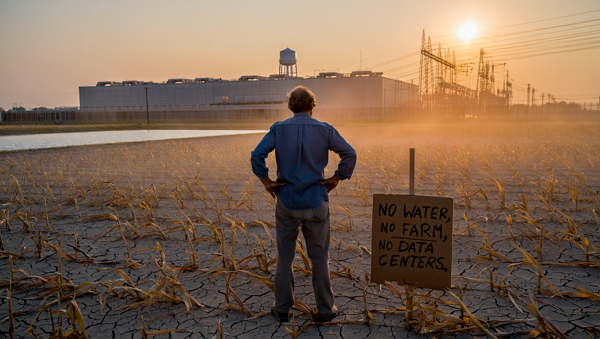
A study found that environmental and health damage costs caused by data centers in the United States amount to $25 billion a year. As artificial intelligence spreads and data centers continue to expand, rising power consumption and air pollution are spilling over into conflicts with local communities, the analysis said.
On April 29 local time, IT outlet TechRadar reported that an National Bureau of Economic Research (NBER) working paper by Carnegie Mellon University economist Nicholas Z. Muller analyzed power demand at about 2,800 operating data centers in the United States and the resulting air pollution and greenhouse gas emissions to reach the findings. The study calculated not only electricity consumption by the data centers themselves but also indirect environmental costs from the power generation that supports them.
Muller estimated total external damage costs at $25 billion a year. Of that, costs directly linked to AI use were put at about $3.7 billion. He also forecast that if currently planned data center expansions materialize, the scale of related damage could rise by up to 85 percent in the short term.
The study in particular said health burdens are growing for residents living near data centers. It said exposure to PM2.5 fine particulates generated in the power production process could raise the risk of lung disease, heart disease and premature death. The study said this creates a structure in which burdens on local medical institutions and residents' healthcare spending also increase.
The power supply structure was also cited as a problem. The study said that under the Trump administration's stance opposing renewable energy, legislation was pushed to restart fossil-fuel power plants that had been shut down to meet surging power demand from data centers. The analysis said this could lead to additional increases in greenhouse gas and air pollutant emissions.
Muller said already-started emissions are likely to lead to future social costs that have not yet materialized. That means the expansion of AI infrastructure by the current generation could be passed on as a burden to future generations.
By contrast, the study said such external costs are often not borne directly by the technology companies pushing data center construction. According to the research, tech companies often receive tax benefits during new data center investments, but in many cases the costs needed to expand the power grid and transmission infrastructure remain a burden for local communities or the public sector.
The study criticized the Trump administration for introducing a "payer protection pledge" to make tech companies bear part of additional power generation costs, but said the scheme was limited to voluntary participation and lacked enforceability or accountability provisions.
Local conflicts are also growing. In some parts of the United States, electricity bills are surging due to increased power demand from data centers, and complaints are emerging that the job-creation effects that had been expected are also limited. Data centers create jobs during the construction phase, but do not employ large numbers on an ongoing basis because automation is high during operations.
The study acknowledged that AI could contribute to productivity gains and economic growth, but said residents near data centers may not view it positively if it means accepting environmental damage and higher medical costs. Against this backdrop, the number of resident groups opposing data center construction is rising across the United States, and some large projects have been delayed or canceled.
Public sentiment around AI is also worsening. A survey found that as many as 71 percent of Americans said AI could cause permanent job losses, and 47 percent perceived a high likelihood that AI could have negative effects on humanity.
As a result, the debate over data center expansion is spreading beyond simple technology investment or AI competition into social conflict over local health, electricity bills, tax benefits and who bears infrastructure costs.
 Jinju Hong
hongjj@d-today.co.kr
Jinju Hong
hongjj@d-today.co.kr