
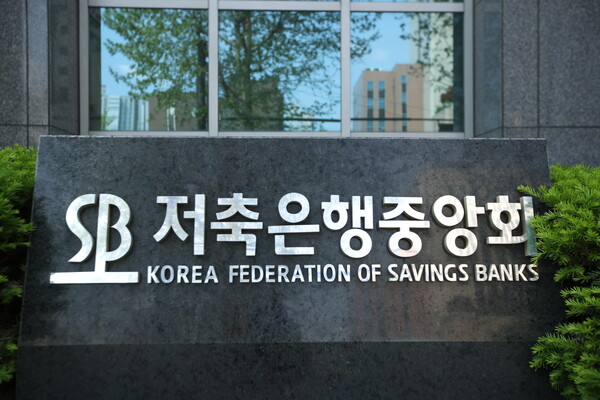
As financial authorities move to revamp savings banks with a focus on expanding productive finance, calls are growing for the industry to make an urgent medium- to long-term structural shift away from a real estate-centered business model and concentration in the capital region.
The financial sector said on Wednesday that the Korea Institute of Finance recently assessed in its report, "Recommendations for the medium- to long-term development of the savings bank sector," that savings banks have continued to expand in size but have a profit structure sensitive to a capital region concentration and the real estate cycle.
The report said assets and loan volumes grew rapidly after restructuring in 2014. As of end-2025, total assets stood at 118 trillion won, up 168.8 percent from end-2015. Loans increased 163.6 percent over the same period, to 88.3 trillion won from 33.5 trillion won.
It said structural limits also became entrenched during the growth process. The share of savings bank credit in the capital region is 66.1 percent, higher than the capital region's share of GRDP of 52.8 percent, worsening regional imbalances. In corporate lending, the share of real estate and construction reaches 44.1 percent, keeping a profit structure with high sensitivity to the business cycle.
Policy lending for low-income borrowers is also concentrated among some large companies. The top 8 firms with guaranteed-loan balances exceeding 300 billion won account for 80.1 percent of the total, confirming market concentration.
To address these structural problems, the Financial Services Commission announced its "Measures for the sound development of savings banks" in February 2026. The key is to classify the sector into 3 tiers by size and apply differentiated regulation, while encouraging an expansion of lending to small and mid-sized enterprises, mid-sized companies and self-employed borrowers, away from real estate-centered credit.
It also presented a direction of overhauling business structures and the prudential framework at the same time through preferential treatment for lending outside the capital region, adjustments to limits on securities holdings, and differentiated application of capital regulation.
The report said it is uncertain whether structural change is possible through institutional reform alone. It said the policy impact could be limited if savings banks fail to secure the capacity to evaluate corporate credit risk on their own.
It said current asset quality assessments at savings banks are centered on after-the-fact indicators such as delinquency rates, limiting their ability to reflect risks before problems emerge. It said a business feasibility evaluation system based on future repayment ability, Forward Looking Criteria (FLC), is needed.
Research fellow Jun-tae Park (박준태) said that for key customer groups such as small merchants and the self-employed, financial information is limited, making it necessary to use assessment methods that also reflect qualitative information accumulated by financial institutions.
Setting the relationship with policy lending for low-income borrowers was also cited as a task. As the role of policy finance expanded after COVID-19, there are concerns that private financial institutions could see their foothold shrink, making it necessary to build a "virtuous cycle structure" that turns users of policy products into private-sector financial customers. The report suggested measures such as differentiating the allocation of policy finance based on performance in absorbing borrowers who make payments in good faith as their own customers.
The report assessed that the sustainability of the savings bank sector depends not on simple regulatory easing or support, but on securing internal competitiveness by improving credit assessment capabilities and expanding the customer base.
The savings bank industry agrees with the direction but highlights practical constraints. A savings bank official said there is agreement on the need to expand the customer base by expanding the role of low-income finance, but an economic recovery must be a precondition.
The official added that as banks secure customers on their own, soundness risks could rise and there is also the possibility of changes in the creditworthiness of key customer groups, making economic conditions important.
The official said moving away from a real estate-collateral-centered business model would ultimately make it inevitable to expand unsecured lending, which would require sophisticated credit assessment capabilities. The official added that for small and mid-sized savings banks, building their own models is not easy given staffing and cost burdens, and a standard credit assessment model at the federation level is likely to be prepared over the long term.
 Ji-young Lee
ljy@d-today.co.kr
Ji-young Lee
ljy@d-today.co.kr