
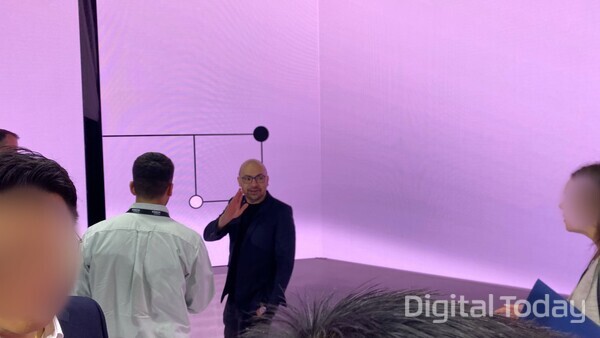
[DigitalToday reporter Seulgi Son] "Over the next 10 years, AI will create remarkable breakthroughs in disease, the environment and energy. It is the start of a new renaissance in which humanity prospers."
Demis Hassabis (데미스 허사비스), CEO of Google DeepMind, said at the 'Google for Korea 2026' event held at the Westin Josun Seoul Hotel on Tuesday that it would "open a new renaissance in which humanity prospers" and laid out a vision to deliver 'AI for everyone' at the frontier of artificial general intelligence (AGI). Hassabis' visit to South Korea was 추진됐다 to mark the 10th anniversary of the AlphaGo-Lee Sedol match.
He said Seoul was "always a special place in my heart" and that the match against Lee Sedol 10 years ago was the beginning of the modern AI era. He added that while it could feel like yesterday, the progress made since then could also make it feel like 100 years had passed.
Hassabis, who won the Nobel Prize in Chemistry in 2024 for AlphaFold, an AI-based protein structure prediction model, led the development of AlphaGo in 2016. AlphaFold is a deep-learning-based structure prediction model that solved the problem of predicting the three-dimensional structure of proteins, a long-standing challenge in modern biology. He said it was "only a taste of the benefits AI will bring to science and medicine."
He also said AI is evolving into a key tool for solving challenges shared by humanity. Just as AlphaFold solved a problem in biology, he sees AI breaking through disease, environmental and energy problems in turn. Hassabis said that within the next 10 to 20 years AI would conquer all diseases and create remarkable breakthroughs in science, including environmental issues and new energy sources, and that this would open a new renaissance in which humanity prospers. He also said the impact of the AGI era would bring an innovative tipping point that unfolds 10 times bigger and 10 times faster than the past Industrial Revolution.
'AI for everyone' is a shared theme among global big tech firms. Major AI companies including OpenAI, Meta and Anthropic are racing to make expanding access to AI a core strategy. As the competition for AI technological supremacy intensifies, the industry is also voicing a common view that its benefits should not be limited to specific companies or countries. This aligns with the South Korean government's AI stance. President Lee Jae-myung said when he met Hassabis on Sunday that he hoped they would open a bright future for AI for everyone 10 or 20 years from now, as they opened the dawn of the AI era together with the AlphaGo match 10 years ago. At the meeting, Hassabis said AGI would become visible within five years, but added that safeguards were essential to prevent misuse.
Google DeepMind, however, did not present a concrete definition or methodology for AGI. Kim Jong-yoon (김종윤), CEO of ScatterLab, who attended a pre-event 'Leaders AI Roundtable', said that when he asked why the jagged intelligence problem occurs and when it would be solved, even frontier labs said they did not yet know the exact answer. He said he was told that three or four fundamental innovations would be needed. Jagged intelligence refers to a phenomenon in which AI handles highly difficult problems excellently but makes errors on simple problems, an unresolved challenge shared by advanced models such as Gemini, Claude and ChatGPT.
Lee Se-young (이세영), CEO of Wrtn, also said Hassabis placed emphasis on corporate response strategies rather than a methodology for achieving AGI. Lee said, "Models change every three months. It was about not making bets that run counter to model progress, and focusing on swap-in structures and harness engineering." Harness engineering refers to a technical system for efficiently controlling and operating AI without being dependent on a specific model.
South Korea's AI potential was also mentioned. Hassabis said South Korea has all the conditions to become a leading AI country, including semiconductors and robotics manufacturing and strong research institutions such as Seoul National University and KAIST. Google will also flesh out cooperation with South Korean companies through this visit. It is working on cooperation in AI and robotics and in education with Samsung Electronics, Gentle Monster, LG Uplus, Kakao, Boston Dynamics and YBM Net, among others.
At the event, Google DeepMind presented a plaque of appreciation to Lee Sedol. Lee said the match was an unforgettable and precious memory in his life, as well as a starting point and driving force for redefining the meaning of his life. He also voiced a cautious view, saying AI should be used as a partner for collaboration and that humans could lose the initiative in their thinking.
 Seulgi Son
sageson@d-today.co.kr
Seulgi Son
sageson@d-today.co.kr