
Samsung Electronics launched the EHS heat pump boiler in South Korea, targeting the market replacing gas boilers. It said the product supplies more than five times the heat energy relative to input power. The company said it operates in extreme cold down to minus 25 degrees Celsius and can stably supply hot water up to 70 degrees under minus 15 degree conditions, enabling it to meet South Korea's climate environment.
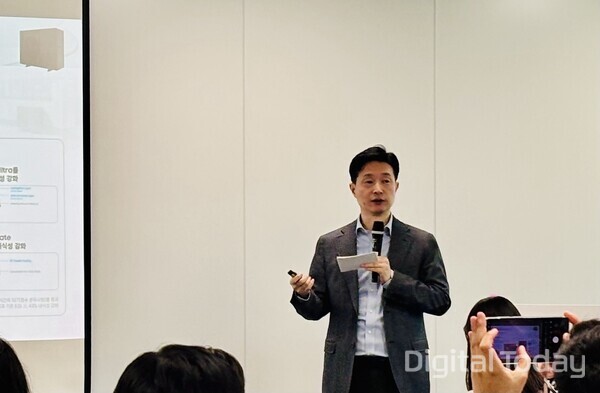
Samsung Electronics held a briefing on April 29 to introduce air-source heat pump-based boiler technology and announced the EHS heat pump boiler's performance and its domestic rollout strategy. With the government starting this month a heat pump boiler support programme for major local authorities including Jeju, South Jeolla and South Gyeongsang, Samsung Electronics plans to participate in the shift to electric heating through product launches and service infrastructure build-out.
The EHS heat pump boiler operates using an air-to-water (Air to Water, A2W) method that transfers heat from air to water. It converts heat absorbed from outside air into hot water through a compressor and circulates it through underfloor piping to provide heating and hot water.
Samsung Electronics said the structure fits South Korea's ondol housing culture based on underfloor heating. It also said the system has high compatibility with existing boiler systems, allowing conversion without large-scale facility changes. It was launched as a "mono" type that supplies water already heated outdoors into indoor spaces.
Under a 35 degree Celsius outlet-water condition mainly used for underfloor heating, its seasonal coefficient of performance (Seasonal Coefficient of Performance, SCOP) is 4.9. Samsung Electronics said that compares with energy efficiency below 100 percent for fossil fuel-based heating equipment and can supply about five times the heat energy. The SCOP under a 55 degree outlet-water condition is 3.78. It applies flash injection (Flash Injection) technology, a high-efficiency refrigerant injection method, and high-efficiency compression technology, and it stably supplies hot water up to 70 degrees even under minus 15 degree conditions in cold weather.
Song Byeong-ha (송병하), head of the Air Solution Team at Samsung Electronics' DA Division, said, "Heat pumps are a key solution for the shift to electric heating and carbon neutrality." He added, "Based on proven technological capabilities and global research infrastructure, we will continue to innovate so that domestic consumers can enjoy stable heating performance and the value of energy efficiency at the same time."
Samsung Electronics said carbon dioxide emissions are about 60 percent lower than those of gas boilers. It uses R32 refrigerant, which it said has a global warming potential (Global Warming Potential, GWP) that is 68 percent lower than R410A refrigerant. A Durafin Ultra coating designed to enhance corrosion resistance is applied to the heat exchanger surface.
Up to five times efficiency relative to input power; enhanced low noise and connectivity
Samsung Electronics also strengthened noise and convenience features. In low-noise operation, it runs at up to 35 decibels, and Song said it is "slightly louder than a library" and "at a level that would not be a nuisance even if installed in a residential area." A 7-inch display controller allows day-by-day schedule settings, and linking with the SmartThings app enables users to check indoor temperature and control it remotely from outside.
When connected to a solar power generation system, users can manage generation, consumption and hot-water storage in an integrated way in the SmartThings app. With a cascade system configuration connecting up to 8 units, it can provide large-capacity heating of 128 kilowatts, covering multi-family housing and small commercial buildings.
Samsung Electronics also presented demonstration results showing heating costs fell about 53 percent after switching to a heat pump boiler at pilot installation households in Yangpyeong. Samsung Electronics operates heat pump research centres and test labs in more than 20 regions including North America, Europe and Japan, and is conducting industry-academia cooperation with the Royal Institute of Technology in Sweden (KTH), Lulea University of Technology (LTU) and Korea University.
Samsung Electronics also said it is researching solutions optimised for high-rise residential environments with Samsung C&T for apartment applications. It said government subsidies cover up to 70 percent, including purchase and installation costs, and the government plans to expand the support target to 3.5 million units by 2035.
 Dae-geon Seok
d2dg@d-today.co.kr
Dae-geon Seok
d2dg@d-today.co.kr