
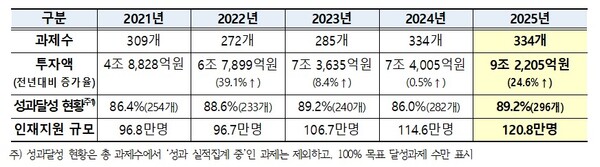
The government invested more than 35 trillion won over five years to support the growth of 1 million science and technology talents a year. In 2024, the employment rate of women in science and technology rose slightly, it was confirmed.
The Ministry of Science and ICT held the 23rd Future Talent Special Committee meeting in writing on April 28. The committee is an inter-ministerial comprehensive coordination body that conducts prior review and deliberation of national science and technology talent policy.
The committee reviewed overall science and technology talent policy. It deliberated and approved a draft 2025 performance review of the Fourth Basic Plan for Fostering and Supporting Science and Technology Talent. The government invested a total of 35.7 trillion won in science and technology talent over the past five years and supported the growth of about 1 million people annually. In 2025, it invested 9.2 trillion won through 334 detailed tasks to support 1,208,000 people.
The committee also approved the findings of a survey on the domestic and overseas stay of science and technology personnel. The survey found the number of foreign students in science and engineering in South Korea last year was 37,943, including 28,651 in university programmes and 9,292 in graduate programmes. By country of origin, Vietnam was the largest at 26.1 percent, followed by China at 22.2 percent and Uzbekistan at 10.2 percent.
In the same year, the number of South Korean students in science and engineering studying overseas was 29,069, including 19,654 in university programmes and 9,415 in graduate programmes. By country of stay, the United States was the largest at 44.3 percent, followed by Canada at 14.4 percent and Australia at 8.0 percent.
In 2025, the number of employed registered foreigners in South Korea among top talents and professional personnel staying for employment and research, job-seeking activities or start-ups was 34,769. The number of South Koreans staying in major countries (eight countries) was 73,528 as of 2024. Japan was the largest country of stay for employed South Koreans overseas at 38.2 percent, followed by the United States at 35.5 percent, Canada at 21.7 percent and Australia at 2.5 percent.
The ministry conducts an annual survey on the use of women in science and technology. A survey of 5,138 institutions on the use of women in science and technology in 2024 found the share of women employed rose 0.6 percentage points from a year earlier to 23.7 percent. The share of new hires increased 0.3 percentage points to 31.9 percent. The share of women in managerial posts was 13.1 percent and the share of women promoted was 19.1 percent.
In 2024, the share of women entering science and engineering programmes was 33.1 percent and the share of women enrolled was 32.7 percent (53.2 percent in natural sciences and 24.5 percent in engineering). The employment rate of female students immediately after graduation was analysed at 64.1 percent, compared with 69.7 percent for male students.
The committee also deliberated and approved changes to ex officio members of the committee, a 2026 implementation plan for the Second Plan for Honours and Support for Contributors to Science and Technology, and a 2026 implementation plan for the Fifth Basic Plan for Fostering and Supporting Women in Science and Technology.
Park In-gyu (박인규), head of the Science and Technology Innovation Office, said, "A country's level and capability in science and technology is a powerful means of reshaping the global economy and the security order." He added, "Through the activities of the Future Talent Special Committee, we will actively work to foster and secure science and technology talent."
 Jin-ho Lee
jhlee26@d-today.co.kr
Jin-ho Lee
jhlee26@d-today.co.kr