
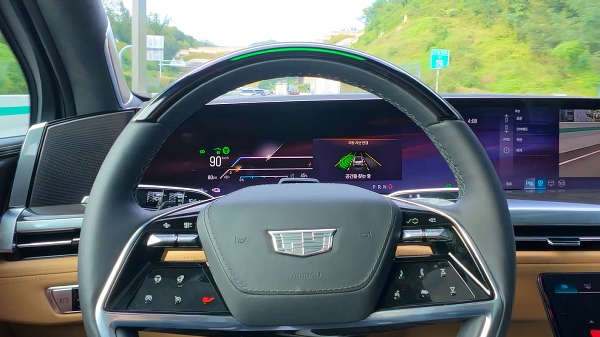
General Motors plans to equip the 2028 Cadillac Escalade IQ with Level 3 autonomous driving functions. Based on 1 billion miles of cumulative Super Cruise driving, it plans to commercialise highway driving that lets the driver take hands off the wheel and even look away.
According to IT outlets Ars Technica and InsideEVs on April 28, GM plans to upgrade its current Level 2+ driver assistance system to Level 3 with next-generation Super Cruise. The first model to get it will be the electric SUV Cadillac Escalade IQ.
Super Cruise was first introduced on the Cadillac CT6 in 2017. It operates only in pre-mapped, restricted areas such as highways and uses an infrared camera to track the driver’s gaze, activating only when forward attention is maintained.
Super Cruise-supported roads have expanded to about 700,000 miles in North America. GM says the feature is installed in about 750,000 vehicles and cumulative driving distance has surpassed 1 billion miles. In 2025 alone, active use time totalled 7.1 million hours and cumulative driving distance reached 485.9 million miles.
GM also highlighted high usage and subscription retention. Super Cruise is provided free for 3 years after purchase, after which an OnStar subscription is required. Rachid Hak (라시드 하크), GM vice president of autonomous driving, said the renewal rate was about 40 percent and that customers who use it once come back.
GM is adding lidar sensors to the next-generation system. Mary Barra (메리 바라), GM’s chief executive, said during an earnings announcement that it was conducting stress tests in a digital environment that simulates about 100 years’ worth of human driving data each day. It recently also started test drives on real roads in California and Michigan.
GM is also increasing its use of artificial intelligence in autonomous driving development. Barra said about 90 percent of the autonomous driving team’s code is generated by AI.
The market is also watching competition with Tesla’s FSD. Tesla has accumulated about 10 billion miles of FSD driving, including on ordinary roads, and has secured 1.28 million active subscribers. GM, by contrast, has emphasised safety and reliability by limiting operating areas and combining that with a driver monitoring system.
The key will be the level of commercialisation in 2028. Level 3 autonomous driving is a stage where, under certain conditions, the driver does not have to keep watching the road ahead. But assessments say it is technically difficult to expand it to internal combustion vehicles and various platforms, as it requires higher computing performance and sensor configurations.
After adjusting its electric vehicle business, GM has positioned autonomous driving as a next-generation core competitiveness. As a result, Super Cruise’s shift to Level 3 is expected to be an important test of GM’s strategy going forward.
 Jinju Hong
hongjj@d-today.co.kr
Jinju Hong
hongjj@d-today.co.kr