
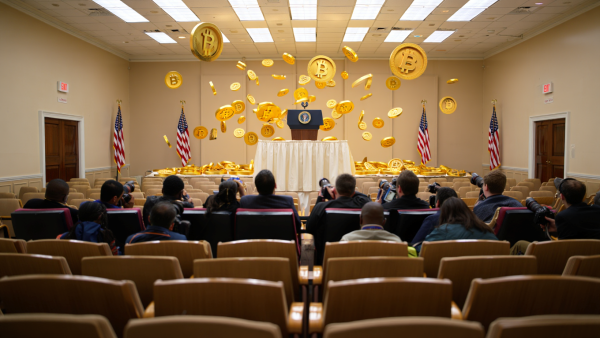
The strategic bitcoin reserve policy being pursued by the Donald Trump administration is expected to reach a major turning point within the next few weeks. With the White House signaling follow-up steps, Congress is reorganising related legislation under a new framework, in what appears to be a move toward institutionalisation beyond an executive order.
On April 27 local time, blockchain media outlet The Block reported that Patrick Witt, who oversees White House digital asset policy, said at the "Bitcoin 2026" event that a major announcement related to the strategic bitcoin reserve would be made public within weeks. Attending as executive director of the President’s Digital Asset Advisory Council, he said, "There was a breakthrough in the process of building the reserve," and added, "We will be able to make major progress at the administration level as well."
Earlier, President Trump set out a framework via executive order to create a strategic reserve centred on bitcoin obtained through criminal and civil forfeiture, and to operate a separate stockpile of digital assets. Executive orders, however, have the limitation of weak continuity when administrations change. As a result, moves in Congress to lock in the policy through legislation are gaining momentum.
A related bill led by Senator Cynthia Lummis and Representative Nick Begich, the "Bitcoin Strategic Reserve Act," is being pushed for reintroduction after a recent name change to the "U.S. Reserve Modernization Act" (ARMA). The move is seen as a strategy to broaden the scope of the original bitcoin bill and expand support within Congress.
The bill is known to have defined bitcoin as a strategic reserve asset similar to gold and to have included provisions to secure up to 1 million BTC over five years through a budget-neutral strategy. It is also expected to include a system to centrally manage bitcoin held by government agencies and operate it under a principle of long-term holding. It has not yet been disclosed what changes will be reflected in the reintroduced version.
The administration and Congress are moving in a complementary structure. The White House is expected to detail in the short term how the reserve will be operated and how the law will be interpreted, while Congress seeks to lock it in through legislation to ensure the policy’s sustainability. Witt also said, "Legislation must follow," underscoring the need for the two tracks to proceed in parallel.
Markets are watching whether the coming announcement will spell out how the reserve will be operated, how assets will be protected, or standards for handling digital assets on the government balance sheet. At the same time, whether the "U.S. Reserve Modernization Act" can advance to an actual legislative stage is also seen as a key variable.
Whether the strategic bitcoin reserve moves beyond a policy declaration to institutionalisation is expected to become clearer soon, depending on the administration’s follow-up announcement and the pace of legislative progress in Congress.
 Jinju Hong
hongjj@d-today.co.kr
Jinju Hong
hongjj@d-today.co.kr