
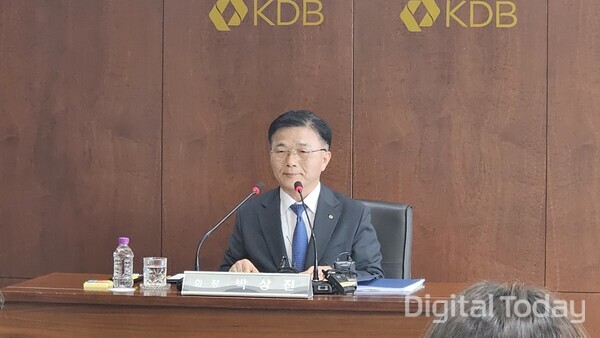
Korea Development Bank Chairman Park Sang-jin (박상진) held his first news conference since taking office and laid out a management plan focused on strengthening industrial competitiveness and restructuring. Park is the bank's first chief from within the organisation after spending 30 years at the policy lender.
On Tuesday, Park held a news conference at the Korea Development Bank's headquarters and said the global economy is going through a paradigm shift marked by intensifying U.S.-China rivalry and a reshaping of global supply chains. He said finance must serve as a catalyst for improving industrial fundamentals and securing future growth engines amid higher tariff barriers and stronger protectionism, as countries compete to foster new industries.
Domestically, he voiced concern that as low growth becomes entrenched, key industries such as petrochemicals and steel are being shaken by latecomers catching up and narrowing technology gaps. He stressed that, as the leading state-run policy bank, he will focus all capabilities on strengthening industrial competitiveness, easing polarisation and contributing to a rebound in potential growth.
◆Fast-track push for 150 trillion won national growth fund over 5 years
He presented the successful management of a 150 trillion won 'National Growth Fund' over five years as a key task. The Korea Development Bank has established a dedicated organisation to oversee everything from sourcing and screening mega projects to post-investment management.
In January, an offshore wind power project with a total cost of 3.4 trillion won was approved as the first project, and follow-on projects are awaiting review. Park said he will achieve an early target of 30 trillion won in approvals in 2026 and deliver results beyond that. He also plans to hold briefings by region so that no company is left out of support due to information gaps.
Separately, the bank will also launch a 'KDB Next Korea Program' totalling 250 trillion won over five years. Under the plan, it will allocate 100 trillion won to strengthening competitiveness in advanced strategic industries, 75 trillion won to expanding finance for balanced regional growth, 50 trillion won to supporting key industries and 25 trillion won to loans and investments linked to the National Growth Fund.
Strengthening the investment function is also a major pillar. The Korea Development Bank is the country's largest policy venture investment institution and has executed direct venture investments of about 500 billion won a year. It will expand the share of follow-on investments as well as new investments to strengthen support by company growth stage.
It will also expand the ecosystem for indirect investment, including scale-up funds to foster unicorn companies and funds to revitalise the market for recovering venture capital. It said it will closely manage the impact of expanding the share of investment assets on soundness, including the BIS ratio.
Park also stressed revitalising regional finance. It plans to supply 30 trillion won in funding to areas outside the Seoul metropolitan region in 2026 and expand regional preferential special products to 15 trillion won from 10 trillion won. It will also create funds such as a regional revitalisation investment fund and a southern region growth support fund to build a support system tailored to demand by region. It also plans to prioritise regional projects when selecting National Growth Fund investment targets.
◆First petrochemicals restructuring case... Daesan plant integration
The news conference also disclosed the first case of restructuring in the petrochemicals industry. The core is the integration of the Daesan plant of HD Hyundai Chemical and Lotte Chemical.
It reviewed the business restructuring plan and self-rescue plan submitted by the two companies in terms of the government's three core principles for restructuring: reducing excess capacity and shifting to high value-added specialty products, securing financial soundness, and minimising impacts on the local economy and employment. As a result, the Ministry of Trade, Industry and Energy completed approval under a special law on Monday. It was also selected as a recipient of the government's comprehensive package support at the ministerial meeting on strengthening industrial competitiveness held that day.
Under the plan, the integrated company will stop operating one naphtha cracking centre unit and cut production capacity through facility consolidation and closure by 1.1 million tons a year of ethylene and 550,000 tons a year of propylene. Instead, it will shift the business toward specialty and eco-friendly products. The two companies will move ahead with a paid-in capital increase totalling 1.2 trillion won, up 400 billion won from the original plan.
Creditors will defer repayment of existing debt of 7.9 trillion won and provide up to 1 trillion won in new funding. Of that, about 430 billion won will be borne by the Korea Development Bank. It will also pursue a plan to convert up to 1 trillion won of creditors' loans into perpetual bonds to fundamentally improve the financial structure, including the debt ratio. The financial support is to be finalised through a resolution of the autonomous council of creditor financial institutions.
On the size of additional capital conversion, including through perpetual bonds, Park said the specific burden ratio will be decided through talks among creditors. He said the basic principle is a burden in proportion to the amount of claims.
He said creditor talks could also be a variable for such financial support. Park said the petrochemicals industry is a national basic industry and a front-end industry, and if it collapses, the entire back-end industry would be hit. He said new funding support could be a burden for financial institutions, but the Korea Development Bank plans to persuade creditors with a structure in which it first bears 430 billion won. He added that for other petrochemical complexes, including Yeosu, it will closely monitor the situation and continue consultations with stakeholders.
Park said finance should play a role in improving the fundamentals of industries in crisis so they can leap again into future industries. He said he hopes this case becomes the starting point for pre-emptive restructuring of key domestic industries.
At the end of the news conference, he apologised directly in connection with a recently raised report of workplace bullying.
Park said he contacted the person as a senior to convey words of comfort, but apologised sincerely for ultimately causing hurt. He said an official investigation is under way at the labour-management grievance handling committee and that strict action will be taken depending on the outcome.
 Lee Ji-young
ljy@d-today.co.kr
Lee Ji-young
ljy@d-today.co.kr